Sunday, March 12, 2023

Vintage of the Century: Act 1


The Judgement of Paris:

Wearing a simple white shirt under a subtly colored sport coat, he appeared a quiet, unassuming young man. He resembled a British gentleman with a closely trimmed beard and mustache, a man who might have played an RAF wing commander in a WW2 movie. I could also easily envision him playing across from Douglas Fairbanks Jr. and Cary Grant in the 1939 movie Gunga Din. He could have filled those roles. And along with that savoir-faire, he carried an air of amusement and displayed a wry, intelligent wit. What was he really about I wondered, and why is he a sidekick to Nicolai?

Z-man met Nicolai while studying at the University of Washington and somehow bonded. A curious thing as he always seemed to me a very different character, who partnered with and yet contrasted to Nicolai, playing the yin to Nicolai’s yang. They had some amazing adventures together, not the least of which was when the fully clothed Z-man accompanied Nicolai on his epic nude ascent of Mt. Rainier. It wasn’t clear at the time how they had come together but Z-man who started out inspecting the sewing of Omnipotents, our distinctive 2-person mountaineering tent, soon assumed the role as head of our direct marking efforts when we created our second Omnipotent catalog.

It made sense, as Nicolai had told me that Z-man had prior experience as a rock and roll band promoter, and even earlier, while in high school had run his own direct mail business selling various fishing lures and artificial worms. Z-man later put that experience to good use when he created the solo mailer that introduced our breakthrough Light Dimension Gore-Tex fabric backpacking tent. Z-man conceived the marketing mailer, performed the graphic work, wrote the headlines and copy, and selected the mailing lists that would reach our target audience. That little mailer surprised us, generating record sales. Z-man was good, really good. As I got to know him better, one thing was clear, he was a curious man with considerable talent and many interests.

‘The Judgement of Paris,’ a title lifted from a story based in Greek mythology, had just appeared in print. But this title referred instead to a story of a 1976 wine tasting in Paris, an event that would turn the world of fine wines upside down. Actually, a competition organized by Steven Spurrier, a British wine merchant. The judges were all French, and the kicker was that the tasting had pitted California wines against the finest French wines of the day. The tastings would be blind with two separate flights, one for the Chardonnay varietal and the other for the reds, California Cabernet versus French Bordeaux. Everyone expected the French wines to sweep the competition, so the tasting was not well attended by the press. If the result was pre-ordained, who cared? Only one journalist showed up.

However, the outcome was an unexpected shock! The French judges and the entire wine world were greatly surprised, actually flabbergasted when the bottles were unmasked and the identities of the highest-ranked wines revealed. The 1973 Stags Leap Wine Cellars California Cabernet Sauvignon trounced the first growth French Bordeaux, the best the French had to offer. And the 1973 Chateau Montelena California Chardonnay had absolutely wiped the floor with Burgundy’s finest white wines. Incroyable! Word of the extraordinary results spread like wildfire through the entire wine world.

I knew Z-man would appreciate this story and its ironic twist of fate. After relaying the article, I proposed that we too should host a comparative wine tasting. It was like tossing chum to a shark. Z-man bit without hesitation, and we soon collaborated on a mission to put together what we named ‘The Great White Burgundy Tasting.’ Why waste hyperbole when you can use it for a fun event? The game plan, the game of wines, was to purchase six notable white burgundies and invite four more friends to dinner and a comparative tasting to experience and learn more about these fabled white wines from France.

Each of the six of us would pitch in $25 to cover expenses for food and wine. Once funded, we commenced, focusing on location, menu, food, wine acquisition, marketing, and education. Initial dining logistics consisted of prepping our tasting space, first by buying a table cloth to cover a construction-grade sheet of plywood that sat on saw horses (my makeshift dining room table). We then bought patterned cloth napkins and a 36-count case of large balloon wine glasses. Six tasting glasses would sit regally clustered in front of each attendee, the tools for comparing and contrasting our subjects, the white Burgundies.

I acquired the wines from a tiny boutique wine shop just off the lobby of Seattle’s then-famous Olympic Hotel. The seasoned proprietor was knowledgeable and delighted to assist in the selection after I explained our concept. The names and places were so intriguing that I was already swept up in the romance of the tasting to come. The wines selected for the flight were a Corton-Charlemagne, a Puligny Montrachet, a Chassagne Montrachet, a Chablis Les Preuses, a Pouilly-Fuissé, and a Meursault-Charmes. A notable group!

Our friends arrived bearing both friendly greetings and eager anticipation. I then commenced, carefully grilling the lobster tails, one for each taster, while Z-man pulled corks and handed out a large menu-sized graphic page with text and maps that romanced the backstory of each wine and what we might expect. In a fit of inspiration, he had designed and written it from scratch for just this one tasting. Printed on a heavy paper stock, it was both marketing, erudite wine information, and a takeaway souvenir of the evening.

We presented the wines slightly chilled and tasted each in turn, slowly pausing to swirl and to comment while they developed as the evening progressed. The wines deserved and received our rapt attention. They were, after all, the stars of the show. And as they warmed up, they blossomed with intoxicating fragrances, aroma, and bouquet, layers of flavors, subtlety, nuance, and complexity. We didn’t then know much about wines. But we knew these wines were special. That much was obvious.

As such evenings go, it was over all too quickly. As our guests left, they each raved about the meal, the wines, and the wine tasting process. Z-man and I found it gratifying to pull it off, the whole enterprise inspired by a blind tasting in a faraway place, the revered city of light, Paris, France. We did not know it at the time, but we had just entered mysterious waters and would soon head toward the deep end.

Saturday, March 11, 2023

Insatiable Curiosity


They appeared as ants, dark specs moving slowly up the immense granite walls of the 3,000-foot rock monolith. The dominating visage of El Capitan was stunning to us, as were the tiny forms of the climbers. We stared at them, as did others, at their systematic, incremental progress toward the top. I was captivated and puzzled. Not content to merely look, I asked myself, “How do they do it?” It was a potentially dangerous question to ask. It could lead to learning the ‘how’ and then rapidly progressing to the ‘doing’ of climbing, an enterprise not without risk.

I held that curious question in mind as we entered the weathered wood structure that housed the Curry Company, the sole outfitter's store in the valley at that time. We added some trail treats to our basket and headed to the wood-planked sales counter. I noticed a small sign next to the ‘Pack It In, Pack It Out’ stickers. It said, ‘Go Climb a Rock.’ It advertised a two-day course in rock climbing instruction for beginners, to be conducted on the rock escarpments little more than a stone’s throw away from the Curry Company store. The price was affordable, and the climbing gear would be provided. I reread the words, decided for myself, and turned to my girlfriend Lara, my sales pitch short and to the point.

“We’re here, and we’ve got the time. Let’s do it.” I said as purposefully as I could. Adventure girl that she was, Lara readily agreed. We signed up on the spot.

And with that, I took what would be my first adventurous plunge into one of the oldest of alpine sports, technical climbing on rock, snow, and ice, the mediums of mountaineering. Climbing soon became my all-consuming passion, an infatuation, an ardent love affair with the spiky peaks and their magnificent wilderness environs. My immersive romance lasted through the years of my youth, until I met that special woman, married, and became a father. I then took a break from alpinism, finally admitting that it was a pursuit not without serious risks and the real possibility of death.

Nevertheless, over the years, the mountains have continued to call and I still journey forth to be a part of their magic and light. I mention my earlier obsession because my current quest with spherical mountain photography is the result of my insatiably curious mind and the same basic question. When I first encountered a 360° panorama I was awestruck. And so again, I asked myself, “How do they do it?”

It has been over 10 years now and most of the practitioners of this curious pursuit still reside in Europe. The preeminent 360 media agency that hosts my images is located in Prague, and Elena, my primary contact, lives in Madrid. To be fair, there are serious and very talented 360° photographers in the states, but there are not many. They are outliers. And, most do not want to pack their heavy photo gear high into the mountains. So, many of the locations I photograph in the mountains are the photographic equivalent of 1st ascents, at least in the realm of 360° panoramic photography.

I hear it more often than you might think. After viewing one of my immersive spherical panoramic images, most viewers are somewhat impressed and yet have no idea what is involved. That is especially true if they experience the photo rotating on my cell phone. They’ll often look at me and say, “What kind of app is that?” or “You must have a good camera.” That default compliment has always puzzled me. I usually just reply that it is not an app and yes, I have a good camera. Why? Because I know their words are well-intentioned, and any further explanation would probably soon have them rolling their eyes, drifting off, and looking to get rid of me.

What? You say you are interested? Seriously? Okay then, here is the ‘inside baseball’ on how I make spherical panoramic images.

As with any photographic subject, one should previsualize the result and seek out the right location, composition, and time of day for optimal lighting. Barring that, you can just impulsively wing it if you see something worthy. No matter the situation, it is critical to achieve a heightened awareness of your surroundings and to note what is static and what is moving so you can adjust accordingly. Though some smartphone apps and dedicated 360° cameras can take a 360° image, none provide high-resolution images with high dynamic range or produce a complete photosphere without some artifact in the ground portion (which I don’t want to see). After all, I am a purist.

So, what’s my process? The approach that I use involves stitching together multiple individual images to complete the full spherical image. I compose my scene, dial in my exposure settings, set up my tripod, level my panoramic camera head, and take eight bracketed sets of perimeter images, every 45 degrees, then a vertical shot (or more than one), two down photos with the tripod, 180 degrees apart, and finally additional down shots with the camera tilted over where the tripod was previously positioned.

Why? Because I use those images in Photoshop to create layer masks to eliminate the tripod and any attendant shadows from the down shot. I often take additional safety shots of the perimeter if I have obvious moving objects like people, wind-blown trees, and clouds. Any movement will have to be de-ghosted from bracketed images in post-processing. And, I use radio triggers to actuate the shutter to avoid camera movement. That also allows me to step back and keep my shadow out of any images. It is especially helpful in precarious places (think sketchy mountainous situations with loose rocks and sheer precipices).

I take three exposures of every image, bracketing plus and minus two exposure values to create a range of exposures that will reveal both shadow and highlight detail. These three bracketed images are then tone-mapped in Photomatix to create one high dynamic range image. I upload all HDR images into Lightroom and make my final selections. Selected images are then processed in Photomatix to merge the bracketed images and create tone-mapped composite HDR (high dynamic range) images. Once I have Photoshopped the tripod from the down shot images, I load the selected eight perimeter images, the overhead image, and the edited down shot into a Dutch software program, PTGui, to stitch the 10 images together into a seamless flat equirectangular image suitable for panoramic viewing software.

Prior to the final output, PTGui allows for image masking, adjustment of stitching lines, and final image orientation. Every stitch line is examined with a virtual magnifying glass to make sure there are no parallax errors where things don't line up The final stitched image is then exported as a large Photoshop file with all individual layers and the composited final image. After the final layer mask adjustments, the Photoshop file is flattened and saved as a Tif file. The Tif file is uploaded to Lightroom for the addition of metadata such as copyright and keywords. Once final exposure and other tweaks are made the equirectangular image is exported to a desktop folder as a Jpeg.

PTGui is used one more time to create a QuickTime file from the Jpeg so the panorama can be viewed by scrolling on the desktop for a final quality control check. At this stage, I often discover something that eluded me earlier and I can go back to the appropriate place in the process to make the necessary adjustments.

The final step is writing the descriptive copy and uploading the image, keywords, copy, and location data to 360Cities.net which will host my image and make it accessible to anyone via the assigned URL. Sometimes 360Cities.net will award me an ‘Editor’s Pick’ which is always gratifying as it offers featured exposure on their site. If I am happy with the results, I tell my friends. Then I am on to envisioning my next subjects.

How long does it take? Well, the fieldwork often involves hours of driving and then hiking into a remote location. I do not count that time as photography is often only part of the reason for the journey. Once on-site. it takes a few minutes to evaluate the subject and adjust exposure settings. After the camera is on the tripod all exposures are created in about two minutes. Post-processing is where the time gets chewed up. It used to take roughly four hours to process a panorama on my old computer but after I built a new computer with a faster CPU, it now takes around an hour, if there are no glitches. Workflow is important and after creating over 500 spherical panoramas, I know what I am doing. Although I am always humbled as I learn something new each time, mostly in the field. Is it worth it? For the right subject, absolutely! I find there is something magical about both the process and the result. Somehow, I never tire of revisiting my panoramas on 360Cites to scroll around and to virtually be in those special places once again.

Here are links to the panorama I took from the Red Pass images with me and my camera setup, and an example that I took of a group of us camping at Colchuck Lake in late September 2019. For best viewing roll over the image and click on the ‘Toggle Fullscreen’ icon in the panel in the upper right of the onscreen photograph. Then scroll to experience the immersive image.

Red Pass Vista with Peaks, Alpine Lakes Wilderness, WA State: https://www.360cities.net/image/red-pass-vista-with-peaks-alpine-lakes-wilderness-wa-state

Colchuck Lake, Alpine Friends, Alpine Lakes Wilderness, WA: https://www.360cities.net/image/colchuck-lake-alpine-friends-alpine-lakes-wilderness-washington-state

Saturday, February 25, 2023

Time To Walk Away

You may have already seen the shattering news. Three climbers lost their lives this last Sunday, February 19. They were swept away in a slab avalanche while climbing Colchuck Peak via the NE Couloir. The headlines grabbed my attention as I know the area well. I had previously climbed the North Face of Dragontail Peak, the larger peak next to Colchuck. And, in late September of 2019, our group of old climbing partners camped at Colchuck Lake where we wistfully gazed at both Dragontail and Colchuck. I still entertained the thought that I might yet climb Colchuck, but via the easier Colchuck Glacier route in the spring after the snow had time to consolidate. I could still do that in my currently fit early 70s I told myself.

When I heard of these recent deaths on Colchuck, I rediscovered an old sadness, the sadness that comes after fatal mountaineering accidents. The devastating loss of climbing friends and acquaintances is always perplexing, even when you know the reasons why. In reflecting on this latest news, I thought their situation and the consequences were unnecessary. They were simply in the wrong place at the wrong time on a challenging and unforgiving route. Having traveled from the east coast over the holiday weekend, they seemed determined to climb in that tight window of time. Any climbing team that travels to a distant destination puts themselves in the position of committing to random weather conditions. As my friend David Stevenson recently reflected, in that situation on-site judgment often takes a backseat to the original plan. The climbers may have been quite mountain fit and technically skilled, but their choices suggest a lack of local mountain knowledge and a blind eye towards cruelly changing weather conditions and unstable snow. And, even if the risky ascent was somehow successful, a potential descent route back down the Colchuck Glacier would be similarly exposed to the same dangerous and potentially life-threatening conditions.

The likelihood of a slab avalanche that day was moderate to high. New relatively cohesive snow stacked over a less cohesive weak layer is a prime recipe for a break that sends one cohesive unit of snow down a slope with the velocity and mass of a freight train. If you are looking for an indiscriminate killer in the mountains, the slab avalanche is it. I read somewhere that the lead climber initiated the break with his ice axe. I can only imagine his horror as the slab broke loose.

As someone with experience climbing the snow-covered peaks of the Cascades, I know that a basic rule is to wait for the right conditions before attempting any route. In winter climbing, sometimes the right conditions never materialize in any given season. And to ignore that would be to court disaster. And, court disaster they did.

They were a team of six. That's another bad idea. The ideal rope team for a steep snow or ice couloir is two climbers. I have climbed both the sensational Black Ice Couloir on the Grand Teton and the steep Stuart Glacier Couloir, each time with one rope mate. It is a better way to make progress quickly, and speed is often a key asset in the mountains. I remember the Stuart Glacier Couloir because that route is physically quite similar to the one on Colchuck. While Colchuck Peak sits beside Dragontail at the head of Colchuck Lake, it is part of the greater Stuart Range and separated from Mount Stuart by only Sherpa and Argonaut peaks. They are nearby neighbors.

Fred Beckey lists Colchuck Peak's NE Couloir route as "a narrow 45% snow couloir (perhaps icy), Grade II Class 3.” By comparison, he describes the Stuart Glacier Couloir, “This extremely alpine route should only be done under ideal conditions. Crampons, hard hats, and at least four ice screws are recommended. Grade III Class 5” (From his Cascade Alpine Guide: Climbing and High Routes Columbia River to Stevens Pass.)

SummitPost.com lists the Stuart Glacier Couloir route under Major North Side Routes and describes it as “Grade III Class 5 + with snow and/or ice to 60 degrees. The route ascends the obvious main couloir above Stuart Glacier. Most of the route is 40 to 50 degrees. The crux is a very narrow section of the couloir about halfway up that frequently involves about 100 feet of water ice up to 60 degrees. The route tops out at or near the small notch on the West Ridge Route. The exit rocks are low class 5 on the normal finish and about 5.7 on the left side variation. There is additional low class 5 climbing on the West Ridge to the summit.”

Both couloir routes are very similar in terms of structure and challenges. But the big takeaway is that Fred Beckey cautions only attempting the Stuart Glacier Couloir under ideal conditions. And because of both their proximity and similarities, neither route should ever be attempted in anything less than ideal conditions.

Climbing.com reported on February 22, “Details about the exact nature and cause of the avalanche are still emerging, but we do know that on February 19, the Northwest Avalanche Center’s avalanche forecast for the Colchuck Peak area (part of their East Central region) was “moderate.” That day’s forecast did note, however, that there was significant wind-slab risk at higher elevations and the avalanche hazard would spike by that evening: from “moderate” through “considerable” to “high.” But because the climbers had been in the backcountry for multiple days and were not traveling with devices capable of connecting to satellite internet, they did not have access to updated snow conditions. None of the climbers, according to UPI, had any formal avalanche training, and none were carrying beacons.”

I suggest that the climbers did not need updated snow conditions from an internet source to evaluate their situation. Why? Because they were right there, next to the peak, seeing and physically experiencing the snow and weather. I submit that their situation came down to both a lack of knowledge and impetuousness. Either they didn’t understand the import of the unstable and worsening conditions and decided to attempt the route according to their original plan, or they did notice the deteriorating conditions and proceeded in spite of them. Probably the latter. A willful decision. Back in the day, I noted a condition that could have great sway on alpine decision-making. It was like a fever. I called it “Summititus.” Rational judgment would simply go out the window because the lure of the summit overpowered all conscious thought. It happened with people that I had climbed with. Somehow, in those situations, I seemed immune to the condition and lived to climb another day. The American Alpine Club will undoubtedly publish this NE Couloir story in their 2023 Accidents in North American Mountaineering. Then we’ll have more information and a thorough analysis of what went wrong.

Unfortunately, only the survivors will have a chance to learn something from it. Instead of betting the farm, it would have been a far better choice to acknowledge the increasingly dangerous conditions, decide their planned climb wasn’t going to happen on the mountain that Sunday, and simply return to Leavenworth for brats and beer at the München Haus Bavarian Grill and Beer Garden. That would have been way more fun and they would still have a great story to tell. But that didn’t happen.

So, I grind on the terrible news that makes me both angry and sad. I do my emotional handwringing because I know what it’s like to be up there and face the dire possibility of death either from one’s own errors or conditions beyond anyone’s control. Often both. That’s the nature of climbing accidents and we need to pay attention to them. All smart climbers study the accidents to learn what conditions to avoid and what not to do. Those lessons, though painful, are essential. Climbers have to be willing to accept that not every grand plan will result in a successful summit. Accepting the failure to summit is just another facet of the game and will often be the stance that keeps one alive. As with many things in life, you must know when it’s time to walk away.

These photos are from my climb of the Black Ice Couloir, as I have none from my Stuart Glacier Couloir ascent. That story appears in ‘Impressions of Ice,’ a chapter about several climbing adventures on snow and ice that appears in my mountain memoir, Banquet of the Infinite, which is available as an illustrated eBook on Amazon, Barnes & Noble, and Kobo.


Thursday, January 26, 2023

It Has to Be Spielberg

“Spielberg? No, he hasn’t called yet.”

“Anyway, his people will probably reach out to my people. Ha, ha!”

“Motion picture or a series? Oh, I don’t know. I’m thinking of a series.”

“No, I have no idea who they might cast. Probably impossibly beautiful people, but earnest and tough with rough edges, like the young Daniel Craig and Scarlett Johansson.”

“Yes, of course, they would. Trust me on this.”

“Absolutely. You should read the original before Hollywood gets their hands on it and some young screenwriter screws it up. Just get it and read it.”

Bill’s fantasy about Spielberg seemed so far-fetched and delightfully silly that I just shook my head. But after I hung up, I thought about it for a moment and took his advice. I bought his book and read it in a flurry of consecutive days, nonstop, savoring each chapter, snickering at the insanely comic moments, and his unsparingly deprecating insights about himself and others. His stories quickly hit their stride with a crazy momentum that propelled the narrative forward. They meandered back and forth in an unpredictable zig-zag path, yet I couldn’t stop reading. Although late at night, I kept going right through the acknowledgments.

Bill graciously thanked his stalwart alpine and outdoor business companions. He stated, “The process of writing has been an interesting conversation, a process of layered reveals as many memories have emerged from the recesses of the distant past, glad to be recognized once again and valued for their rediscovered truths. I am hoping that after reading these stories that many of you will say. “Damn it’s already over. I wanted more!” And if you do, know that I feel exactly the same way.”

I closed my eReader, lay back in my bed, and closed my eyes. I thought he said it well. Very well, for that’s exactly the way I felt. I too wanted more. As I drifted off, I couldn’t stop thinking about Bill’s friends and their crazy adventures both heroic and foolhardy, as my subconscious mind filled with colorful moving images.

Other readers also wanted more. We all clamored for it. We’d impatiently ask, “What’s next?” We hoped that someone with imagination and resources had the creative energy and resolve to bring Bill’s friends and their stories to life in some form of dramatic cinematic experience. In my mind, the adventures would most benefit from the big screen, but that’s just me. In any case, the production designers and director of photography would have a wonderful opportunity to create a visual feast, the likes of which would hold audiences spellbound, with jaws agape from scene to scene, from the curious first chapter to the final credits.

Well, that conversation seemed so very long ago. Yet we continued to wait with bated breath. Bill’s unusual 70s-era memoir continued to garner more than its fair share of media attention and praise. Readers simply loved it. And that’s an understatement. They’d share their favorite stories on Facebook, often exclaiming, “I laughed out loud. I couldn’t believe it, and yet I totally believe it. So funny!” Even the silly catchphrase, “Throw in a short block” entered the popular consciousness. You heard it everywhere. Most often whenever someone suggested something ridiculous, a notion that had a high likelihood of going sideways in an endearingly funny way.

Fans of the offbeat book continued to ask, “Why is it taking so long?” With the mixed bag of recent Oscar nominations behind us, we turned our speculation to proposed and upcoming projects. The still rumored film adaptation of the hilarious mountaineering memoir, ‘Banquet of the Infinite,’ came to mind. Many wondered who would be cast as Edwards, the romantic alpine dreamer. But more attention was focused on the mercurial Svengali, Nicolai. Who would play this egotistical yet endearing, fearless leader of all things rock, ice, and snow? And what of their colorful, quirky companions? So far, all was shrouded in secrecy. At that stage, we could only wait and wonder.

Yet there we were, months on, with no confirmed studio commitment to the rumored ‘Banquet of the Infinite’ project, be it a movie or streaming series. And yet, the rumors continued to swirl around who would play the leading roles. Many speculated an ensemble cast to assume the quicky characters: Edwards, Nicolai, Z-man, Pete ‘The Cheese,’ the wild-haired Fielding, Nordic Denny, Roy ‘The Boy,’ the innovative Schonhofen, the irascible Rainer, and the barefoot hiking sensation Larry Horton. Then there was the endearing factory crew, Pat, Betty, Max, and Ernie, who wore silver shears upon their chests. And, let us not forget the essential ‘adventure girls’ the gritty, sassy, and oh-so-capable young women who frequently accompanied the boys on their mountaineering adventures. Unsurprisingly, Judy, Lara, Pam, and Diane all received more speculation than the guys. Their inclusion was not only foundational as complex characters in their own right but also as comedic foils for their male companions as they quested forth toward their testosterone-fueled alpine mishaps. So, who would play these daring, intrepid young women? This was an enduring question that we all wanted to be answered, the sooner the better.

The distinctive roles would demand much from the entire cast. How could they effectively portray both the external and internal lives of these complex characters? And, they’d obviously need comedic talent and the physical wherewithal to scale granite peaks while making it look easy. And, those peaks would challenge the film crew as well. I didn’t see those scenes filmed against a green background on a soundstage somewhere in England or New Zealand. It’s going to take real mountains folks, and the actors will need to practice their hand jams, ice axe skills, and rope handling to make their moves absolutely convincing. Perhaps a few young leading-edge climbers should be considered. Would it be easier for them to achieve acting skills than actors becoming adept climbers? I don’t know. It was something for someone else to ponder.

Despite the rampant speculation on social media, choices for the male characters were still not obvious. Unsurprisingly, Diane told Bill that she wanted Angourie Rice to play her. That casting choice seemed perfect to him. And, many fans had already proposed Aubrey Plaza, or someone like her, for the spicy redhead Lara. While many comely and athletic young actresses might play the others, most fans eschewed the Hollywood regulars. Some ardently proposed lesser-known actresses from Canada or Australia, yet we noticed no overwhelming consensus amongst the fans. The casting crew would have their hands full unless they had some unusually inspired notions, which I counted on. All of us desperately wanted the stories to meet and surpass what we imagined they could be, with actors and actresses who brought them to life with such an endearing authenticity that we couldn’t help falling in love. We’d just have to wait and see.

Where would it be filmed? If the powers that be remained true to the book, the choices were obvious. In the actual places where the stories occurred, Washington’s Cascades, the Sierra, the Wind River Range, and the Tetons. Of course, the budget might require some consolidation of the mountain venues so the cast and crew wouldn’t be traveling excessively. And, let’s not forget the weather. It wouldn’t act on cue. Sometimes they’d need bluebird days and other times those unforgiving, yet cinematic, mountain storms. It was no easy task. And what about luck? They’d need lots of that. Oh well, the location people and the DP would have to figure it out.

The sets would present an intriguing opportunity to take the ‘Wayback Machine’ into the mid-70s, to a much simpler time, providing ample opportunity to make each location distinctive and memorable. Hopefully, their designs would be so well rendered that the sets become charming characters in their own right. What a terrific opportunity for a set designer! I thought of the former family grocery store on Queen Anne, home of the Early Winters shop and the Alpine Guild, Flatland Packworks’ diminutive space next to the Hasty Tasty on the Ave, and the old country church in Victor, Idaho, the curious location of the fabled Rivendell Mountain Works. There were few photographs to work from, save the church. But truly inspired designers would bring the author’s descriptions to life with busy, beautifully cluttered sets.

While casting speculation continued at the forefront, other questions still remained. If the book is not adapted as a series, how would all those stories fit into a single feature film? Hmmm, no easy answer. But what to cut? This commentator suggests none! I submit that the stories are all so funny they have to be included. I say we should consider a trilogy or a quartet of films, and even a prequel to give full rein and allow the stories room to breathe. Am I right?

“What a minute. Is that my phone?”

“Bill, is that you? You got the call? Are you serious? Yes. Okay. They’d like to option ‘Banquet of the Infinite.’ Did I hear that right? Yes, I understand that you’re interested. They want you to meet with Steven? Of course, you said you’d be happy to ‘take a meeting’ with him.”

“Roger Deakins too? You say he’s already envisioning scenes? You may not know it, but I absolutely love his work. And Steven’s too. Yes, I’ve seen most of them. Liked them all. ‘Close Encounters’ is my favorite, and ‘The Adventures of Tintin’ a close second.”

“What? Harrison Ford read it too? Wow! He’d be awesome in it if only he could have done it back when he first played Indiana Jones. Darn! Well, I am gratified and impressed that he likes your book enough to mention it. That’s really something.”

As we talk, I muse to myself that I’m super glad that Spielberg is undeterred. Bill’s book doesn’t fit neatly into a pre-ordained niche. It takes a truly creative and adventurous thinker to acknowledge that and forge ahead with a vision of what it could be. I always considered him that kind of guy, unconventionally creative. I know some will argue with me about that but to hell with them. I keep listening to Bill.

“They want you there tomorrow? Well, you just have to do it! Get on that plane. Don’t hesitate. Yes! Time waits for no one. Tempus fugit my friend. Might as well get the proverbial alpine start. No, I agree. Yes, completely. You definitely lucked out. No, I can’t think of anyone else better to make it. Keep me in the loop. Okay, later.”

I hung up, exhaled, and hoped for the best. Bill is a hopeless romantic and truth be told, a bit naïve. I didn’t want to see his work mangled by some studio money man. So, I took heart that it was Spielberg. That reassured me, a lot. I figured that if anyone could make ‘Banquet of the Infinite’ fly, make it soar with golden wings, he was the one to do it. I crossed my fingers and poured myself a Scotch, the Macallan 12, Sherry Cask. Seemed appropriate.

Months passed, and filming finally began. The location shoots were as much an adventure for Bill as his first exploits in the mountains and the cottage industry outdoor business. Unlike what he might have expected as the original writer, he was invited to participate. What? That just doesn’t happen. When is the last time anyone heard of a writer going on location? But there he was, with everyone making him feel included and valued. He even had his own director’s chair with his name stenciled on it. Ridiculous but true. He traveled to the original mountain venues with cast and crew and savored the wild places and unpredictable weather all over again. Spielberg, ever the perfectionist, even occasionally asked Bill for his thoughts on the climbing scenes as he wanted to get it right, period correct. And Bill was also given free access to everything. He could come and go as he pleased and he took full advantage of it. I know it doesn’t make any sense, but somehow that’s how it was.
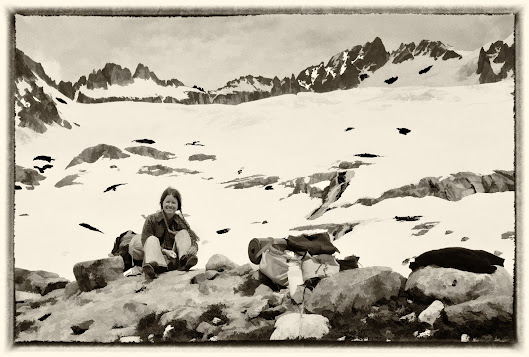
The entire cast was comprised of fresh new faces. They all seemed well suited for their roles and eager to imbue their characters with the raw energy and power of youth. They certainly seemed to have the potential to transfix and delight audiences of all ages. Bill had many great conversations with the talent at the craft tables. Incredibly, all of the actors and actresses had actually read the book before they tackled the script. They’d fallen in love with the stories and their characters. There was something about those stories that really resonated with people.

During the course of the shooting, mostly in between takes and at the end of the long days, Steven and Bill bonded over more common childhood experiences than either could ever have imagined. Crazy right? Of course, Roger and Bill became fast friends, even though Bill’s still photography was as child’s play compared to Roger’s extraordinary mastery of the cinematic medium. Roger shot everything digitally, often using the innovative ARRI Alexa Mini, the tiny carbon fiber titanium-bodied camera, selected specifically for the technical climbing scenes.

The days passed with the usual challenges and reshoots, but time never dragged. Every day an adventure. And, as with the adventures of his youth, Bill lamented that it was over way too soon. You could tell that they all felt that way. On the last day on the set, Steven encouraged Bill to stand up and announce, “It’s a wrap.” They all laughed and hugged and said their heartfelt farewells.

Bill called me later and over dinner told me stories of life on the sets in faraway locations. At times he paused and seemed lost in a wistful trance as if he was still there in the wild outback with a bustling film crew and committed actors. As a lifelong film buff, he clearly loved the experience. He raised his glass of Pinot Noir and exclaimed. “What a wonderful group of people. I couldn’t have wished for anything more. I will forever hold them dear in my memory.” In that fleeting moment, I felt my eyes get a bit moist, so happy for my friend.

The digital files were now in the hands of the editors. From time to time, I thought about them and wondered what scenes would survive and what would be cut. In my mind, I could see them reviewing clips and deciding what to keep and what to leave behind. I had no idea how much they were working with. I had just heard that it was a lot.

When ‘Banquet of the Infinite’ finally arrived at the multiplex, I was there, standing in line to see it on the big screen. I couldn’t wait for streaming. And, despite my trepidation, the film didn't disappoint. It was actually damn good, just like the reviews. Besides the accolades and obligatory criticisms, the pundits all speculated about the release dates of the sequels as they had all been filmed at the same time. They too clearly wanted more. It was a common theme.

What seemed like interminable months later, I sat on my couch, staring at my flat screen, and hoping that our dreams could indeed come true. I drifted through the talky monologues and impatiently waited. Then, I heard it.

“The award for Best Adapted Screenplay goes to ‘Banquet of the Infinite.’ And, here to accept the award is Steven Spielberg.”

Steven gave a charming speech and at the end held up his Oscar with words of thanks and a salute to Bill for capturing the amazing stories that led to making his now favorite film. I’m not kidding. Later that evening, ‘Banquet of the Infinite’ would capture awards for Best Actors and Actresses, Director, Cinematography, Production, and Movie. The Grateful Dead heavy soundtrack achieved a nomination but did not win. And the scruffy outfits of the climbers did not even merit a nomination for Costume Design. To say that I was both surprised and elated would have been an understatement. I picked up my phone and called Bill. And as I expected, he too was euphoric! He felt no small amount of satisfaction in finally telling the adventure stories of his youth and having them writ so large on the big screen. They were now part of the larger consciousness and would live forever. So, I guess, sometimes dreams do come true!

Brrrr… Brrrr… Brrrr… Brrrr… Brrrr…What the hell? Fuck!

God that’s annoying. I really, really hate that alarm!

As I rolled over and pulled the covers back over me, the colorful images of celebration gracefully receded from my mind as ephemeral as wisps of smoke, soon to be replaced with the irrepressible bright sun of the new day. I couldn’t stop it. 


Saturday, December 17, 2022

Peaks and Pencils


When I first scanned my old film photos to digital, I didn’t remember or recognize the place. I found that puzzling and frustrating. It was obviously a thoughtfully planned trip taken with two old friends. A celebration of sorts. Was it the Enchantments? No, despite the rugged alpine quality of the terrain, it was not.

As I reviewed our journey through my photographs, I felt that I was there once again. I almost physically felt the oppressive August heat as we struggled up the off-trail route on our ascent from the end of the Necklace Valley Trail at Opal Lake. We negotiated an exposed and relentlessly challenging boulder field. Our goal? To seek out and camp near a pristine pair of isolated lakes. Lakes with breathtaking views of some of the most rugged peaks in Washington’s Alpine Lakes Wilderness. Our quest was to savor solitude in a visual paradise.

Ensconced in rocky granite basins high in the Central Cascades, Tank Lakes are small bodies of water so remote that there are no signs of civilization. There are no visible highways, clear-cuts, or nighttime light pollution. In short, a hidden gem of a place. One could easily compare the environment to the Enchantments, but without the crowds or need for a lottery permit.

We arrived exhausted but quickly pitched my Early Winters Starship, the prototype of many to come, on a granite shelf overlooking a lakeside snowfield. We had traveled almost 12 miles and gained 4,300 feet in elevation to achieve our mountain camp. The stats belied the difficulty as the route finding and scrambling ascent made the day seem even much longer than the numbers would suggest.

Once there, the view to the southwest summits held us captivated. Though we didn’t know their names at the time, we admired Little Big Chief, Summit Chief, the three spires of Chimney Rock, and Overcoat Peak, all between seven and eight thousand feet in elevation. Scattered snowfields blanketed their north faces, adding another dimension to their dramatically sculpted verticality.

That day we casually meandered about, exploring the Tank Lakes basin throughout the afternoon hours and into the orange hues of the sunset, always looking back towards the dazzling array of peaks on the southern skyline.

As I wistfully recall our trip, I found that now, 40 years later, I yearn to return, to be there again. An even more adventurous trip would be the pilgrimage to Tank Lakes with an added backcountry traverse over Iron Cap Mountain and rigorous off-trail travel out the West Foss River drainage. Fred Beckey named the remote and magnificent loop the “Alpine Lakes High Route.” It would become known as a difficult and demanding traverse, one that should be only attempted by seasoned mountaineers. Nonetheless, it’s tempting. Very tempting. Undoubtedly the trip of a lifetime.

In the meantime, I find I can commune with the rugged place just by sketching the peaks with pencils. So often when we view a place or look at a photograph, our experience is of the gestalt, the overview, but when we sketch and paint, we are inevitably drawn towards more considered scrutiny of form, texture, color, light, and shadow, and the relationship of objects. It’s my experience (of course, echoed by others) that drawing becomes a way of seeing that deepens the perceptions and experiences of the artist. These pencil sketches are my way of immersing myself in the place, once again, just by examining the peaks more closely. And through the process, I see the dramatic alpine scene with new eyes. And now, some four decades later, return to Tank Lakes.


Thursday, November 24, 2022

Reflections on Granite

Granite again? Well, yes, and when I think about it, I hear the Eagles enthusiastically singing “Take it to the limit. One more time.” This last hike was my thirteenth time (actually 13 ½ if you count that ignominious episode when I got caught out in a downpour halfway up and without rainwear). Probably a modest number of ascents when compared to others, but a baker’s dozen is nonetheless a magic number.

I remember a year's earlier ascent in late June. We experienced a brilliant sunny day with wildflowers blooming, including a profusion of lupine, Indian paintbrush, columbine, and Beargrass blossoms. And, once past the high-angled meadows, we encountered the first snow fields and the trail became indistinct. Once at the steep ridge to the fire lookout, we had the choice of scrambling up through a jagged jumble of granite blocks or taking the snowfield. We opted for the granite and soon regrated that decision. While the upper granite near the lookout has more flat blocks and is easily navigable the lower sections are a mess of large sharp blocks jutting every which way with no obvious clear path other than up. It was hugely frustrating, consuming lots of time, and we almost bailed on the hike. “You know we don’t have to go to the top.” “I know.” Having acknowledged that, we then kept on up the granite for a bit longer and then stepped off to the snowfields, kicked steps, and continued up. It was a glorious sunny day with Mt. Rainier and Mt. Stuart clearly visible. We spent about half an hour having lunch and visiting with other hikers at the historic lookout. A day to remember.

Another memorable trip was the result of my fascination with night sky photography. I was looking for dark sky photo opportunities and conceived a Granite Mountain Galaxy Quest to achieve the photographic equivalent of a first ascent. Being familiar with the site, having hiked to it several times before, I previsualized the composition with the relative positions of the fire lookout, Mount Rainier, and the Galactic Core. Then, I contacted some friends to share the adventure with and we waited for the right conditions to come together.

Mark and Chase jumped at the chance when I invited them to join me on a hike up Granite Mountain to photograph the Galactic Core of the Milky Way. Then we hiked. Packing photo gear and overnight kit up 3,820 vertical feet was brutal but soon forgotten as we dined on Mark’s scratch-made smoked turkey sausage camp stew and settled in for the light show. I worked the camera into the dark as the GC appeared in the southern skies over Mt. Rainier.

There was no campground. It was a bivouac situation. We needed to shoot late into the night sky and then either hike out in the dark with headlamps after the shoot or pack sleeping bags and pads and bivy until dawn and then hike out in the daylight. Because of the potential for injury hiking out in the dark on this trail we elected to bivy. I got 3, maybe 4 hours of sleep, but it was worth it!

Waking at dawn, we reluctantly packed up and hiked down from the site of the night sky magic. We counted 102 people coming up Sunday morning as we descended (even before the Pratt Lake Trail intersection). Party up top! We decided to award a mini chocolate bar to number 100 and since the universe is a strange place, number 100 was a woman who Mark had worked with at K2. Of course, Diane was delighted with the chocolate prize and seeing her old friend Mark again. Really. You can't make this stuff up. Trip verdict? Priceless!!!

I have reflected that the hikes to Granite Mountain Lookout are always a standout experience as the changing seasons offer a continuing opportunity to experience the scenery in new and ever-fascinating ways. The hike is at once both comfortingly familiar and yet intriguingly new, like reconnecting with a long-lost old friend.

So why was I now hiking it again? It was both the lure of fall color and the need for wooden shingles. The Snoqualmie Fire Lookouts Association was seeking volunteers to carry wood shingles up to the lookout for a roof repair (after last week's llamas flamed out after a mile last week). I almost went for the llamas, but didn’t. Who wants to be stuck behind a pack train for four miles, no matter how cute the animal? I would wait. And now, while I equivocated about the possibility of being part of a conga line of happy hikers with shingles (wood shingles), I decided to be a part of it. It was an opportunity to give back and maybe meet some fun people.

I snagged one of the last parking spaces in the lot at 7:40 am, and after some milling around as folks unloaded the shingle packets from a truck, I moseyed up, signed the register, and picked a bundle. I found a medium-sized packet that slid snugly into my 50-liter pack. There were no coffee gift cards. But they did have homemade chocolate chip cookies, which I forgot to sample. I just wanted to get going in the cool of the morning, before the inevitable heat that would come later in the day.

The first two miles of the trail in the shady wooded section were the usual study in browns and greens, almost monochrome. The dusty trail snaked up the mountain meandering through ever-steeper rocky sections. The first mile is easy and then, after the trail split, the rocky route gets down to business. This is the section where I’m still warming up and I’m asking myself why I ever thought this was a good idea. Why indeed? Well, it’s for those gorgeous upper mountain meadows that are festooned with Beargrass blossoms in the early season and aflame with color in the fall. It always takes my breath away.

I was surprised that there was no conga line and not surprised that I met some interesting fellow hikers. After breaking out of the woods, I made my way up through the meadows, which I regard as the best part of the hike. The arduous earlier ascent would be behind, and while there is still much elevation to be gained, it’s far more pleasurable. Yes, the trail is still chockablock with boulders but this section flows upward, and I feel as if I am dancing with granite, as the sheer magic of the hike reveals itself. This is the place where you can go faster but you are best served if you slow down and let the magnificent scenery just wash over you. Today we hiked through a heart-stopping visual symphony of fall color. I could hear Wagner’s dramatic operatic ‘Flight of the Valkyries.’ I didn’t want it to end, and yet we had more work to do.

We continued on the summer route to avoid the boulder-strewn ridgeline and ascended the tedious backside switchbacks up to the final rocky ramp to the iconic Granite Mountain Lookout. Always a visual treat!

After handing off our shingle packets, which were immediately taken up into the lookout, we found places to sit and refuel. Even after hiking slowly with frequent pauses to sip water, I was surprised to note that I had arrived in 3 hours and 15 minutes. It felt slower than that, more like four hours. By now it was quite warm and the skies were clear for miles, four volcanoes visible from the lookout. Even Mt. Stuart made an appearance. The vibe was friendly and festive, with groups of hikers savoring the day. I felt suspended in time as Elizabeth made a summit espresso which she drank from a tiny stainless cup, the silhouette of mighty Mt. Rainier visible in the background as thin clouds streaked across the horizon. What a day! This is why we do it.

As I descended, I encountered many more shingle-laden hikers on the way up, some complaining about the strenuousness of the hike. Hey, as one seasoned hiker observed in a trip report from long ago, “No matter how fit you are, Granite always kicks your butt.” Why is it so I asked myself? I think it goes beyond mere stats of mileage and elevation gain as it is, often, an obstacle course of granite that makes you work harder for each step than you’d ever expect. Of course, one can always aspire to dance with the granite. I like to imagine that on my best days that I am dancing, flowing like water, upward through the boulders up to the historic fire lookout, the visual epicenter of my quest. Visualization is, I think, so important as we disappear into the mystic. 

I confess that I took no heavy camera gear on this last ascent as the shingles were enough. In the past, I have hauled my serious camera and tripod up and made several spherical panoramas from the summit. But in case you are interested, I took a spherical panorama on Sept 12, 2019, that shows what the summit looks like on a sunny cloud-filled day without the snow on the ridgeline. A day much like today. And I include the link to one I took the morning after our 'Granite Mountain Galaxy Quest.' 

For best viewing click on the ‘Toggle Fullscreen’ icon in the panel in the upper right of the onscreen image. Then scroll to experience the immersive image. I have many other spherical panoramas from wilderness adventures that are hosted in my portfolio at 360Cities.net. And, there are several more on Granite Mountain. Just Feel free to look around.

Granite Mountain, Summit Friends, Alpine Lakes Wilderness: https://www.360cities.net/image/granite-mountain-summit-friends-alpine-lakes-wilderness-washington-state

Granite Mountain, Dawn Patrol, Alpine Lakes Wilderness:  https://www.360cities.net/image/granite-mountain-dawn-patrol-alpine-lakes-wilderness-washington-state-usa


The Light Dimension

Workingman’s Dead rolled on the cassette player, the Grateful Dead cranking out an energetic version of “Uncle John’s Band.” Always one of ...

Beers in the Stream