Saturday, June 11, 2022

Drawing Towards Transcendence


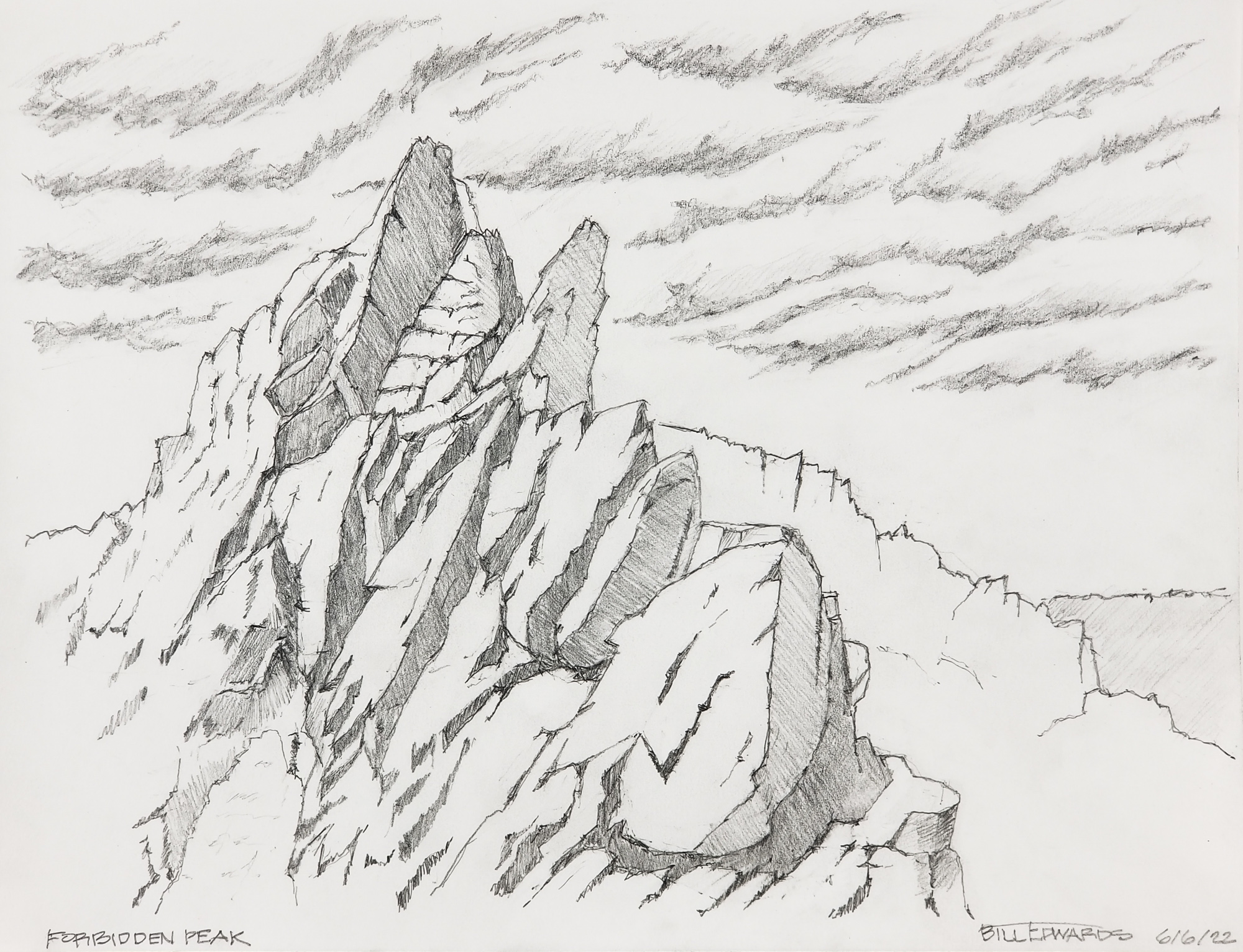
As I sorted through my old art supplies, I recognized my favorite pencils and held them, once again. The feeling was familiar and filled with promise. I examined my old sketchbooks, opened one, and started marking marks on paper. Cautious at first, reticent, facing the blank page, I feared the possibility of making a trainwreck of a drawing. I proceeded slowly, gradually regaining confidence and then surprisingly experiencing emerging joy.

Several months ago, my wife suggested that I might enjoy a return to watercolors. I found her suggestion curious since I had not painted in many years. Having finished a prior project, writing an illustrated memoir of the mountain adventures of my youth, I was now free to try something new. Perhaps she sensed that I would benefit from a new project that would focus my now untasked mind. After some consideration, I agreed that her suggestion had merit.

Soon, old art supplies were exhumed from closets and cardboard boxes and assembled before me. Where to start? I had no idea about the subject matter and was quietly concerned that I might experience a void. When in doubt it sometimes makes sense to start moving forward and see what happens. That had worked for me in the past. So, I began by assembling paints, drawing a grid, and painting color charts on an expansive sheet of watercolor paper. As I wielded a wet brush with paint over the textured paper I once again felt like a child.

The physical sensation of moving water and pigment on paper is so amazingly tactile that I knew I wanted to keep going. Beyond the color charts, I chose mountain scenes from prior hikes and climbs. So much for my concern about the subject matter. As I examined the mountain adventures of my past, I realized that I had found a deep well, which was reassuring. Diving in, brush in hand, it was soon evident that boldly splashing color on paper would not satisfy my creative desires. To more fully explore the medium and convey my chosen artistic vision, I needed to improve my artistry through drawing.

I recalled reading that Vincent Van Gogh spent an entire year practicing and mastering drawing before he proceeded with painting. He made that conscious decision because he felt the quality of his paintings would depend on those drawing skills. Even intuitively, I knew he was right. But, unlike Van Gogh, I never considered spending a year devoted only to draw. Perhaps I could do both, jumping back and forth between watercolor, pencil, and ink.

Yes, the pencil could be a most valuable tool. And to effectively use it, my first quest would be to see subjects more deeply again. The art of seeing would be the backbone of any artistic practice. My seeing needed to become sharp and finely honed. And in concert with seeing, to utilize drawing to more accurately render subjects, compellingly portray a range of values, and create visual drama, all in the service of achieving a more robust foundation for watercolor painting.

My practice with pencil soon evolved, becoming so much more. As I proceeded, I realized that part of my attraction to pencil sketching was its more forgiving nature. While one can stop partway through a watercolor to pause, rest, and assess, there are natural break points. For example, it might not be in one’s best interest to pause and stop partway through a wet-in-wet sky unless an expert at resuming. The humble pencil allows one to stop anywhere, and that’s valuable. Unlike watercolor, most pencil mistakes can be corrected. And your trusty eraser can be an effective drawing tool, useful to remove and change, and even reveal highlights in smudged clouds. Pencils and paper are so accessible, contained, and portable. Why leave home without them?

But a deeper, more profound reason to draw with a pencil was the need to soothe my soul and to merge with that magic world that I could create on paper. A first, I felt compelled to draw a completely literal representation of my chosen subject. It seemed like the right thing to do. But, more often than not, I found it tedious and needlessly frustrating. The rock and structure of granite peaks, a favorite subject, were often confounding in their complexity. And I struggled. Eventually, from my frustration emerged a valuable insight. I realized that I was under no obligation to slave away, trying to accurately convey every detail. Who makes the rules anyway? The pencil police? No! Absolutely not! I’m in charge! Whew.

At that moment, I realized great freedom, the freedom to creatively interpret my subject. Of course, I realized it is not a new concept. Most artists, especially those who instruct, are specific and clear when mentioning this concept, and perhaps a mandate, to freely interpret the subject. The door had opened. And, I found it significantly more impactful to leap from the cognitive recognition of that concept to the actual ‘ah ha’ experience driven by my personal insight at the moment.

Literal or figurative, that would be the question. And to what degree? I suppose a literal rendition would be mandatory for an illustration in a climbing guidebook or such publication. But in a memoir, with ‘look back’ stories told through the haze of recollections, an interpretative approach would certainly be acceptable, even irrefutable. In fact, it would probably be preferable as a means to illustrate the most significant elements retained in one’s selective memories of places and events from the distant past. And beyond the conveyance of memories, and probably more importantly, the figurative expression provides a doorway for the artist to convey what is most meaningful to them, whether from a compelling memory or a current vision. It makes perfect sense in the context of creating powerful and memorable art.

With my newfound freedom to interpret my mountain landscapes comes the ability to shift perspectives, change the depth of field, simplify details, change the direction of sunlight and shadow, create skies with any type of clouds I might imagine, and even, more remarkably, move mountains! I never imagined that I would someday so easily move mountains. But best of all, I’m creating a world to which I more deeply belong. The spiritual nature of the experience is significantly enhanced, and I find myself more at one with my creation. And that is perhaps the greatest gift of all.

All artwork is by the author.

Friday, June 3, 2022

Naked Ascent


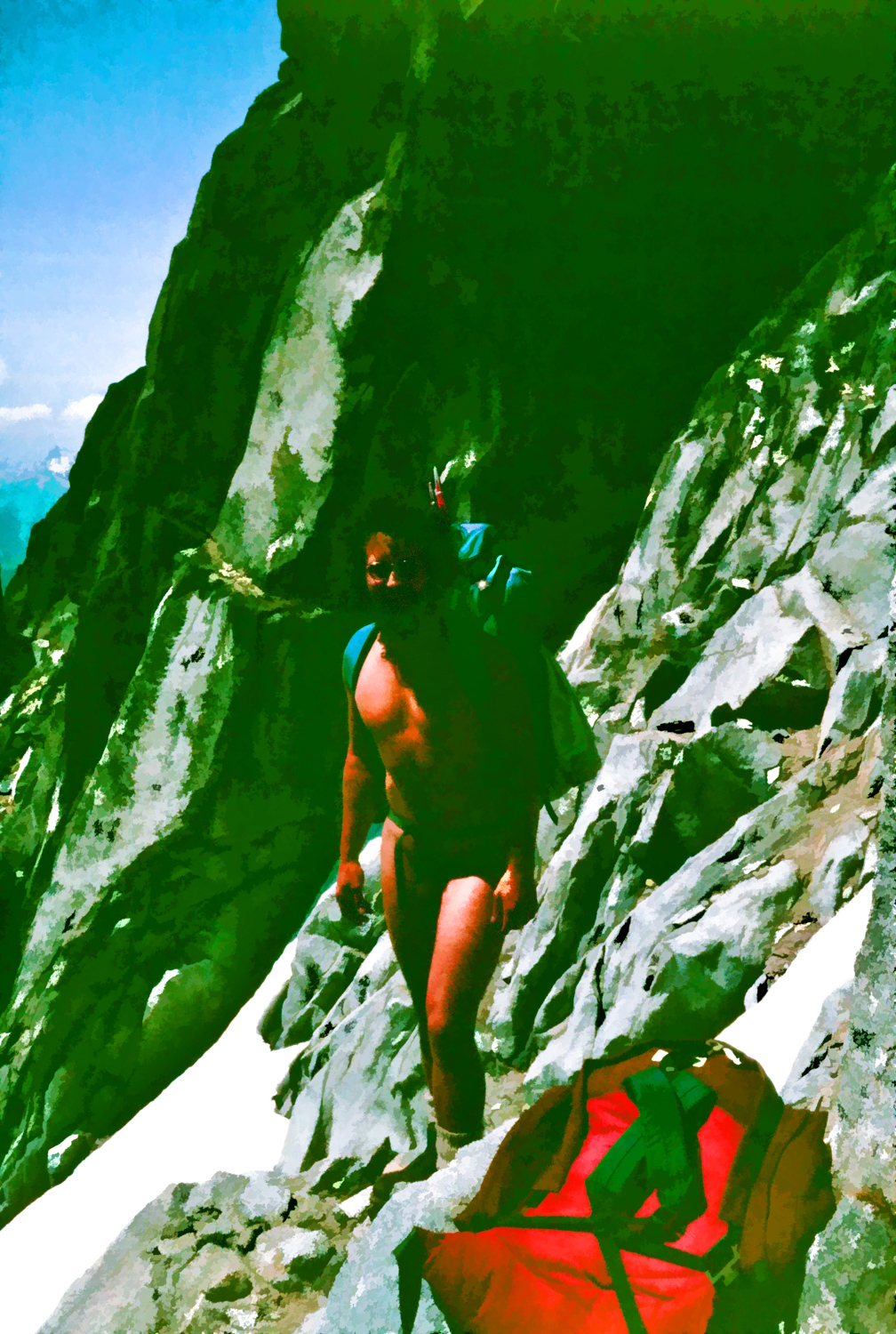
We were soon at the base of the West Ridge route on Mount Stuart. I cheekily suggested that we might want to climb it nude. Nicolai readily agreed. He was known for his nude ascents, especially his first nude ascent of Mount Rainier, probably the only one by anyone ever. A stunt that seemed a bit crazy, and one with no small amount of bravado and risk. I heard that the weather on Rainier, that day of his nude climb, had been perfect, or he would not have been able to pull it off. But pull it off, he did.

The weather on this day was perfect, the risk of freezing to death was, unlike on Rainier, slim, and I was eager to try this outrageous naked climbing thing by making a nude ascent of the West Ridge of Stuart. It seemed like a good idea at the time. We dropped our packs and took off our clothes. We stuffed them into our rucksacks and began climbing upward. I was self-aware in a whole new way. At first, I felt a bit smug. The heat of the sun warmed my skin, a satisfying sensation. This nude climbing was a cool thing to do. Definitely.

We climbed un-roped since the difficulty level of the route was well within our capabilities, and it also helped us make up some lost time. We stayed close together, climbing in tandem. Pitch after pitch went by, and as we got higher on the ridge, the immense scale of the mountain became ever magnified as I looked around and down. As we climbed further, a thought occurred to me. What if I fell? I didn’t expect to take a fall. Falling was a remote possibility in my rational mind, but the seemingly irrational thought wouldn’t go away.

By now, the novelty of climbing naked from one jagged granite block to another had worn off. No longer smug, I was just a small, naked climber, a mere speck, on the West Ridge of the mighty Mt. Stuart, the single greatest exposed mass of granite in the United States. My thinking had progressed to envisioning my small crushed body found bloody and naked on the rocks below after a horrendous, terminal fall.

For some reason, I thought it would certainly be okay for my lifeless body to be found, fully clothed, but not to be found stark naked. No, that wouldn’t do. I continued mulling this over, perhaps overthinking it. Yes, I was definitely overthinking it. I climbed on and upward and as we neared Long John Tower, reached a decision. I called out,

“Hey Nicolai, hold up. I’ve had enough of this naked climbing. I’m going to put my clothes back on.”

Without a word, he patiently waited, and after I had hurriedly rejoined the world of the clothed, he turned, and we both continued up the ridge. We hadn’t seen anyone else on the climb and thought that we might have the entire route to ourselves.

We soon came upon a group of four climbers. They were all roped up and geared up as if they were attempting the North Wall of the Eiger. Even though this was a ridge climb, they all wore climbing helmets. It seemed a bit much. They looked like they might be right out of a Hollywood movie about climbing an extreme European alpine route. One of them had some blood on his face. It looked like a close encounter with a rock during a belay, but I couldn’t tell for sure. I didn’t ask.

They had stopped and clustered together, presumably discussing either the injury or the route, or both. We suddenly appeared, two scruffy-looking guys climbing un-roped with minimal gear, one aboriginal, tautly muscled, darkly tanned, and stark naked. Of course, now I wished that I hadn’t put my clothes back on because the shock value would have doubled, but it was too late.

The four turned and stared as we approached, mouths open, no words. The buck-naked Nicolai shouted out,

“Do you mind if we climb through?”

They nodded as if in a trance, and we climbed quickly past them, resuming our un-roped ascent. And as we did, I examined their faces and was shocked to recognize two of them.

Those two were the same guys that worked behind the hardware counter at REI. The climbing hardware at REI sat in a glass-fronted counter, a display case not unlike what you’d find at a jewelry store, presenting precious hunks of forged and machined metal bits precisely arranged, displayed like objects of art. 

The floor behind the counter seemed raised. I always felt the guys who worked behind the counter were looking down at me. They were a shopper’s nightmare, conducting themselves as self-absorbed, narcissistic smug little know-it-alls. Consequently, when I wanted to physically examine something that resided inside the display counter, I always felt like some poor small wretch out of a Dickens novel.

“Please, sir, may I see the piton?”

I bought some climbing hardware at REI in my early mountaineering days. I found their attitude so disagreeable and unpleasant that I quickly transferred my subsequent hardware purchases to the Swallow’s Nest. I named them the hardware punks in my mind. They were so full of themselves that I grew to despise them.

To see them now on the West Ridge, fumbling around like incompetents, was better than laughable. It felt like redemption. So, the undeniable truth was that there was no foundation whatsoever for their self-assured smugness. The curtain had been pulled back and the hardware punks revealed for the posers they were. I laughed heartily inside, a very self-satisfied laugh, as we swiftly left them behind, arguing amongst themselves about what to do next.

Nicolai and finally I roped up and belayed each other for the more difficult 5.6 layback crux pitch near the summit and then, un-roped again, deftly made our way up the jumbled granite blocks to the top. The sun was slipping towards the horizon, painting the sky in warm orange hues. As we paused on the summit, Nicolai, bronzed and naked, crouched like a primate eating peanut M&Ms from the bag. We rested there, savoring our accomplishment and the view ahead.

Nicolai was in that monkey-like position when the four climbers appeared below and began making their way up the granite blocks, slowly coming towards us. I could only imagine how Nicolai’s crouching silhouette might have appeared to them with the fading sun behind us. It might have well resembled the opening sequence of 2001: A Space Odyssey, the Dawn of Man scene that featured the dark apes. 

Before they arrived at the summit, we were up and gone, already descending towards the saddle between Mt. Stuart and Sherpa Peak. We would not see or think of them again. And it was there, in the rocky granite saddle, we bivouacked for the night, settling into our down sleeping bags, staring wordlessly up at the pinpoints of ancient lights in the moonless sky, as our conscious thoughts slowly faded to black.

This is an excerpt from ‘Climbing Naked,’ a mountaineering adventure story about our ascent of the West Ridge of Mount Stuart. The story is told in my mountain memoir, Banquet of the Infinite, which is available as an illustrated eBook on Amazon, Barnes & Noble, and Kobo.

Photos and mountain art are by the author.

Saturday, May 28, 2022

Race Day

May 1966, Champaign-Urbana, University of Illinois, Forbes Hall, room 306. That spring of my freshman year, two friends and I gathered to form a plan. It didn’t take long. We impulsively left campus that Sunday afternoon and drove toward Indianapolis. Our ride: My friend’s '60s something 4-door Mercury sedan. Our destination: The Indianapolis Motor Speedway Why? To attend the Golden Anniversary Race of the Indy 500, the 50th running of the race, and the 150th anniversary of Indiana statehood. We planned to arrive in time for pre-race festivities, party, spend the night, and watch the race the next day.

Like most kids in the ‘50s and'60s, my brother and I were obsessed with cars. While too young to drive, we built Soap Box Derby racers and even had a modest go-kart that we’d race around parking lots until someone called the cops, who chased us off. I remember disassembling the modest Clinton engine in our garage and porting and polishing both intake and exhaust with my Dremel MotoTool. Of course, it increased the horsepower, and the aftermarket aluminum exhaust header made it insanely loud. No wonder we got chased off, everywhere we went. And, as we passed the days with our childhood toys, we yearned to drive the real thing.

When we visited the Chevy dealer to get our Soap Box Derby regulation wheels and axles, we’d often pause to admire the new Corvette. Back then, cars were a celebration of design, full of voluptuous curves, abundant chrome, and outrageous tailfins. Buicks even featured non-functional ‘ventiports’ on the front quarter panels, the number of which would signify the size of the engine. Four ports on a quarter panel signified a mighty V-8 under the hood.  And on top of the various physical design elements, automotive paints were many and varied, from bright colors to seductive pastels. And, many cars with two-tone paint jobs still cruised the roads. White, black, and gray were not yet the most popular car colors. Auto enthusiasts looked eagerly forward to each new model year and many of our neighbors would routinely trade in their old models for the latest sheet metal from Detroit. One family we knew from the Soap Box Derby, bought a new Chevy every year. Our family did not. After all, dad had a black 1957 Jaguar 3.4-liter sedan with red leather seats. Pretty classy. Of course, I lusted after the XKE.

We hadn’t planned well. We just took off. As we approached the enormous Indianapolis Motor Speedway traffic jammed up and we crept toward the tunnel entrance that would take us to the infield. We bought our tickets and entered. Our seats would be in the unreserved bleachers on the backstretch. We figured that would be good enough for us.

The infield area was already filling up with cars and we navigated through the crowds and parked campers to an open spot and pulled in. We had arrived. The field was full of enthusiasts already in full party mode, grilling burgers, hotdogs, and chicken and drinking beer, lots of beer. As the day turned into night, the party kept on going and pyramids of empty beer cans towered high. We finally headed back to the car and turned in. Yes, we slept in the car with only our jackets for warmth. The truth is that we didn’t sleep well at all.

Dawn arrived and somehow, we sallied forth on a new day, race day. We made a beeline to Gasoline Alley to see the cars. Back then we could get very close to the race cars and the mechanics that hovered over them. There was only a close-in chain-link fence that separated us from the activity. We found it thrilling to be in such proximity to the pampered machines and examined the sleek contenders for some time. After more wandering around the gigantic speedway, we headed over to our bleacher seats on the backstretch and waited. The day was way bright and hot. We baked in the sun as we waited. The distant sound of engines crackled through the air. Soon the pace car would lead the starting grid through the pace lap and the race would begin.

We stood transfixed as the parade of cars rounded the backstretch curve and headed past us, stately, waiting for the pace car to exit in front of the grandstands and for the race to commence. As they disappeared, we eagerly waited for the full-on racing. We soon heard a deafening roar that meant they were off and running, soon to come racing by us. But that didn’t happen. The roar was inexplicably brief and then there was silence. No cars rounded the curve coming toward us. There was absolutely nothing. A complete void of activity.

We impatiently waited, baking in the relentless Indiana sun, wondering what was going on. Incredibly, there was no announcement. And it took quite a while for the word to finally filter back through the crowd to the unfortunates sitting on the hard wooden backstretch bleachers. We would eventually learn of a huge sixteen-car pileup and that eleven of the 33 starters, all damaged beyond repair, were eliminated in that horrendous first-lap accident soon after receiving the green flag on the main stretch. 

After the crash, a red flag came out as damaged cars were removed from the track. When the debris was cleaned up, the remaining cars were again lined up, and the race restarted after a delay of an hour and 24 minutes. When the race finally resumed, we were famished and grateful to our neighbors who shared some of the fried chicken they brought from home. Although exhausted, we had come this far and we were not leaving now. So, we settled in and watched the cars race to the end.

The famous world champion English racer Jim Clark had won in 1965 and was in the field, racing his Lotus again. I was an ardent fan of his accomplishments in Formula One racing and had come to see him drive and achieve a second victory. His 1965 accomplishment was groundbreaking as he was the first to achieve a win with a mid-engine car. He drove a Colin Chapman Lotus powered by a Cosworth Ford engine. 1964 was the first year of the ‘English Invasion’ with the Beatles topping the music charts. And a year later in 1965, another ‘English Invasion’ happened at Indy. It marked the end of the era of front-engine cars that had existed since the beginning of the race in 1911 when Ray Harroun won in his Marmon. 

While the English drivers were all well experienced with the twisty European Formula One circuits, the victory really had more to do with the cars than the drivers. Their automotive engineering was superior. The lower polar moment of inertia achieved in the mid-engine design allowed the vehicle to maintain stability at higher speeds through the turns. Their exemplary performance was achieved through adherence to the laws of physics. And once that was conclusively demonstrated, the mid-engine configuration was widely adopted and thus began a new era for Indy cars.

Fortunately, only A.J. Foyt, the winner in 1964, was injured as he hurt his hand trying to scale the fence to escape the scene of the spectacular sixteen-car wreck. Eventually, Scottish Jackie Stewart, the 'Flying Scot,' would lead the race late in the day and was a full lap ahead when his oil pump failed with only ten laps to go. Fellow rookie, Englishman Graham Hill then took the lead and finished first in his mid-engine Lola/Ford. Jim Clark spun twice that day and finished second. Curiously, only seven cars finished, the fewest ever in the history of the race.

By the end of the long day, only made longer by the interminable delays, we were ready to leave and joined the slow parade of vehicles that departed the infield. The party was finally over, and we were completely bushed. As we left, I sat in the back seat of the Mercury and wondered if I would ever return to the Indianapolis 500. And as it turned out, I did not.

Sunday, May 22, 2022

Stone Gardens and Golden Trout

Driving up Highway 168 from the arid little town, our view expanded. A colossal range of high peaks arrayed dramatically before us. The air seemed thinner and more ethereal. There was something to that because Bishop, residing near the northern end of the Owens Valley, is sited at 4,150 feet, and we were continually gaining elevation. Our destination, some twenty miles west, further up the narrow two-lane road, ended with a small pullout and a place to park. We paused at the trailhead and reflected that we had driven some 1,300 miles from Seattle. The next leg would be on foot. We unloaded and sorted our gear on the ground next to the car, both wondering what lay ahead.

Fortunately, we weren’t starting in a storm. That thought was a remnant of Pacific Northwest thinking. The sun shone bright overhead, and the trail was a dusty, rocky affair that climbed steadily up, the heat of the day requiring frequent stops to pull out our water bottles and slake our thirst. The narrow path was well defined and straightforward, crossing through areas of subalpine meadows that hosted wildflowers, native grasses, and gnarly dwarf trees. The surrounding peaks appeared timeless and fractured, their cracked flanks displaying the prominent rubble of their massive talus slopes.

We noticed the dry fragrances of the Sierra, an intoxicating sensory perception of pine needles, tree barks, and hints of wildflowers. The waters of Lower Lamarck Lake shimmered in the sunlight, sparkling brilliantly. Even in the hard light of the Sierra, the azure blue waters and the structure of the surrounding landscape reverberated with a bright intensity painted in visually arresting saturated colors. Significantly different from the light in the Pacific Northwest. We stopped at Upper Lamarck Lake to refill our water bottles. Pushing on, Mt. Lamarck watched over us.

Approaching Lamarck Col, a rocky pass from which we would descend towards our yet-to-be-determined camp, we looked back at the Lamarck Lakes and the tiny trail behind us. A mere thread of dirt. Our goal for the day: to climb steadily upward to the rugged rocky col, at 12,880 feet, and then drop down into Darwin Canyon, hike along the canyon lakes and search out a suitable camp for our first night.

The trail up to the col was steep and rocky, and the sun relentless, but coming from the Pacific Northwest, we didn’t mind. We encountered what seemed to be a permanent snowfield up near the col and, after kicking small steps, gingerly traversed it, and soon gained the col. We paused to break out our water bottles and take in the view. Across the canyon, Mount Darwin and Mount Mendel dominated the skyline, massive gray forms with sharp spines, aprons of snow, and fields of talus and scree at the runouts.

The scale of the landscape was vast and desolate, hard and unwelcoming. We descended, picking our way slowly through the jumble of rocks on a faint and seldom traveled trail. A chain of five small lakes, arguably tarns, all at about 11,600 feet above sea level, was visible at the bottom of the canyon. They led to the canyon exit and out to another small tarn at the Darwin Bench. Our first camp.

The smaller more intimate landscapes by the lakes hosted rough grassy meadows that were quite welcoming. Pitching my newly acquired Omnipotent #13 on a lakeside spot, we cooked our modest dinner and watched the sunset. The days were long, and we’d used most of today's, so we were tired and happy to turn in. After a few words about what might lay ahead tomorrow, we fell into an exhausted slumber.

A new morning dawned bright with the promise of wild places to come. After a quick breakfast, we packed up our gear, shouldered our backpacks, and hiked cross-country to connect with the John Muir Trail. We hiked south down the JMT through the Evolution Basin, passing the sparkling waters of Evolution Lake, and Sapphire Lake, and arrived at Wanda Lake. One of the larger lakes in the basin, flanked by rugged granite peaks, Mt. Huxley, Mt. Warlow, Mt. Goddard, and Mt. McGee, we found it stunning and welcoming. The friendly lake became our base camp.  We pitched our tent.

We hiked up to Muir Pass, to the iconic rough stone Muir Hut, sited at 11,955 feet. Constructed in 1931, it resembled a medieval granite beehive with its vertical octagonal walls and cone-shaped rough stone roof. The design of the monument, inspired by the vernacular 18th-century Trullo Huts of southern Italy, looked perfect in its environment, amongst the granite boulder field on the knoll of its construction. The heavy, weathered wood door seemed out of an ancient legend. I grasped the heavy hand-forged steel handle and pressed the thumb latch. We entered.

The room was dark and empty save for a rustic timber table and a large, soot-darkened, stone fireplace that dominated one wall. While cool inside, there was little more to see. Recessed, in an outside wall, a cast brass commemoration plaque told a brief story of the John Muir Memorial Shelter. Built in 1931 by the Sierra Club and the U.S. Forest Service, the brass plaque dedicated the stone hut to John Muir, ‘Lover of the Range of Light.’ We paused to envision the construction. We were alone, and in the calm of the day, took our time, thoughtfully running our fingers over the surfaces of the stone hut as if paying homage to a sacred place. The silence was absolute.

We explored several more sapphire blue High Sierra lakes, often clustered together in small groups and always beneath rugged towering mountains. We scrambled up the blocky flanks of many of them until we felt the limits of our skills and rested, gazing out over the immensity of surrounding basins and high granite peaks. Alone for most of our journey, we saw only one other group of backpackers. We encountered them at one lake as they passed through. Three, young as ourselves, hiking by day, camping, and fishing for trout.

Lara and I fell in love with the Sierra, destined to return to this same area two years later. We increased the range of our explorations. We’d travel off-trail following the contours of our topo maps, hiking up the drainages of streambeds and cascading waterfalls to fish remote and seldom visited lakes with boulder-strewn shoulders. If you wanted to simply wander and discover, this was a good place. More than good. Sensational.

We hiked along a meadow stream set high amongst the magnificent stone gardens of the Sierra. Meandering through the meadow, framed by shaggy, wild grass banks, the water was clear and clean, gurgling over small polished stones of many colors. I saw movement as dark shapes darted under cover of the banks.

Guddling for trout was new to me, but today I would try. Easing into the knee-high sparkling waters of the frigid stream, I moved slowly towards the undercut banks. I bent low to ease my arms deep under the edge, carefully searching with curious hands. I felt a slim undulating object. Cupping my hands gently under and around the reluctant trout, I eased it out and up to the surface, barely above the water, to marvel at its bright and shining sides, a truly dazzling creature.

A diminutive member of the trout family, the California golden trout are a native fish distinguished by their dark green backs, saturated golden flanks, and bellies punctuated by bright orangish-red stripes along their sides. Visually they are simply pure magic, intoxicating to behold. I held the small trout briefly, reverently, as it took my breath away and then carefully lowered it back into its waters. I practiced guddling a few more times as we hiked along the stream that day, amazed at each unique brightly colored trout. I could not have imagined anything more beautiful.

Those early days of our exploration of the Sierra revealed to me, much more emphatically than I could ever have imagined, the ethereal magic of nature. My experience was profound and the beginning of my deep spiritual communion with the wild places of the mountains. And for that, I would be forever grateful.


This is an excerpt from ‘Stone Gardens and Golden Trout,’ an adventure story from my mountain memoir, Banquet of the Infinite, which is available as an eBook on Amazon, Barnes & Noble, and Kobo.


Sunday, May 15, 2022

The Winter Route

While there are several ways to the top, most of us focus on two, ‘The Winter Route’ and ‘The Summer Route.’ Of course, there are variations of each, but the main thrust is that once the snow has consolidated, sometime in the late spring, and the avalanche chutes no longer pose life-threatening danger, we have a window in time when we can ascend the ridgeline to the lookout on snow, ‘The Winter Route.’ And that’s fun. Big fun, if you like toting an ice axe and kicking steps, with or without spikes, depending.

Yes, I’m talking about the hike up to the Granite Mountain Lookout. It’s an all-season hike, except when the snow makes for prime avalanche conditions. Even with the snow at the higher elevations, it’s beautiful in the spring and summer, festooned with blooming bear grass and other wildflowers on the approach. And in the fall, the abundant mountain ash and huckleberries provide truly spectacular colors. Unfortunately, no subalpine larches are turning brilliant gold in late September / early October but the alpine meadows are rich with stunning hues of reds, oranges, and golden ochres in the late season.

The last time I ascended the ridge crest was on the 3rd of June, 2020, hiking solo. Starting at 7:30 am, the crisp morning chilled me. But soon after the first mile, I peeled off a layer since I always find it impossible not to work up a sweat in the forested section after the Pratt Lake Trail junction. It’s where the trail quickly steepens, rapidly gaining elevation over ever more boulder-strewn terrain. The trail was in good shape with negligible mud. After emerging from the verdant forest, the beautiful day featured mostly blue skies, with only the wispiest of drifting clouds, all the way from the upper meadows to the historic fire lookout.

I encountered snowfields at 4,700 feet around 9:30 am, and the last 1,000 vertical feet were entirely on snow. The snow was soft enough that microspikes were not required (I had them in my pack just in case). My poles were useful for stability on the less steep slopes but I switched to my ice axe for the ascent of the steep ridgeline and was happy with that decision. I was also wearing stiff-soled mountaineering boots which were very helpful in kicking steps on the way up and plunge stepping on the way down. Mountain boots and an ice axe provided me with a sense of confidence and security.

While there was a path in the snow, it was days old and I kicked my steps. The upper ridge featured a prominent cornice on the upper section before the lookout. I took note and avoided venturing too close to the edge. As snowmelt had begun, there was a cleft between the upper snow slopes and the granite boulders in several places along the upper ridgeline. They were sharply undercut and required cautious attention so as not to punch through to the granite boulders below.

There would be more melting in the days ahead and while I could ascend the entire ridgeline to the lookout on snow today, that would soon become impossible as the snow melted out. The ridgeline route would then become a combination of rock scrambling and snow travel. And that combination would be far less fun. I knew because I had done it in years past.

That day in early June was simply pure magic! And even though we were amid a pandemic, I hiked early and only encountered 3 people descending as I ascended and I had the lookout all to myself for a leisurely snack before heading down. As I descended, I soon passed others on their way to the top. All were smiling. It’s that kind of place.

Once the snow has departed, it’s much easier to access the lookout by traversing a high meadow below the summit ridge and ascending a rocky trail from the north. The last switchbacks up the rocky path are steep, and it’s always a relief when the lookout comes into sight. The cabin is rarely open, and I have only been in it once during maintenance work by the rangers. Open or not, it is an amazing piece of history and a wonderful place to sit and snack and enjoy the views.

For panoramic views without the snow, I invite you to look at my spherical panoramas. I have taken seven at the historic Granite Mountain fire lookout. All have vistas of the nearby peaks. The links below feature two examples that can be viewed at 360cities.net. Others may be accessed by scrolling below each image and clicking on the ‘Nearby’ tab. Be sure to click the full-screen icon as you roll over the upper right of the photo for best viewing. 

Granite Mountain Fire Lookout Cabin: https://www.360cities.net/image/granite-mountain-fire-lookout-cabin-alpine-lakes-wilderness-washington-state

Granite Mountain Cirrus Clouds: https://www.360cities.net/image/granite-mountain-cirrus-clouds-alpine-lakes-wilderness-washington-state


Saturday, April 23, 2022

Thinking Small

‘Think Small’ The simple headline was unprecedented. Bursting onto the scene in 1959, the unusual ad campaign was probably the most famous ever created by the Doyle Dane Bernbach advertising agency. Stunning everyone, it announced and positioned the VW Beetle in a completely new way, changing the very nature of advertising during that era. No one who ever saw it forgot it. It was ‘sticky’ before that word entered the broader lexicon, more tenacious than merely memorable, it was truly unforgettable. And we talked about it.

It was akin to a messaging tsunami. Why embellish product pitches with questionable platitudes? Why not state a position based on an obvious truth and challenge your target audience to think? Even though a pre-teen, I was already obsessed with cars and the simple ad did not escape my attention. I thought it brilliant. Such restraint, and yet confident, with undeniable clarity, cutting through the clutter, standing defiantly alone. Advertising Age ranked it the best advertising campaign of the century.

And now, many years later, I recall it once again, as I have recently embraced a discipline of small, a way to progress in the art of seeing, and craft of art, for both my drawing and watercolor painting. When starting, or resuming after a long absence, the fear of failure and the daunting white of the blank page often hold one back, barriers to our learning and success. And also, the notion that we should jump right into watercolor painting with a larger format, perhaps a sheet of 22” x 30” cold press cotton paper. For anyone but a master painter, it’s a likely recipe for disappointment and an impediment to making progress with the medium. In short, a discouraging event of no small significance.

Paint small and often seems like good advice. I’ve heard that statement more than once from those who teach. And the same would apply to drawing, an essential skill that provides a foundation for more successful painting. Think about it. A tiny piece of paper, the real estate of a painting, is less precious, and less expensive. The drawing or painting is contained in a sketch-like format. It’s less formal, with a lower barrier to entry, which means that it’s easier to plunge right in. The fear factor is significantly reduced, more iterations can be churned out, and that faster production cycle makes it easier to quickly attain skill, evaluate results, and make progress.

When taking art classes in college, we usually started with a large format in our studio classes, and a 9” x 12” sketchbook, with a homework assignment to complete five sketches a day. The frequency of that assignment helped us progress, but we took shortcuts, tackling portions of subjects as a study. What would have been better? Thumbnails.

I have recently gridded out pages of my cheap sketchbook paper so that I can draw eight thumbnail sketches on a page. Yes, they’re comically tiny, but the fear factor is gone, so it’s easy to work up a form and value study quickly, in fact, several of the same subjects in short order. I hadn’t known what I was missing. It’s a freeing experience to make quick sketches, or little watercolors, in a thumbnail format. And, they tend to be more spontaneous, loose, and exuberant than larger studies. And that means that the process, and the results, are both curious and fun. And fun is a key reason why we do this.

Confidence is a key attribute for the artist in the realm of painting, as it is in rock climbing or the discipline of mixed alpine. Of course, it is an attribute attained through practice and the building of skills in your chosen medium. And anything that removes barriers and makes practice more accessible and frequent will propel one towards mastery and confidence. I have become a believer. These small studies are foundational for both skill-building and exploration of ideas before committing to a larger format. They function as a bridge between a concept and the finished work. I now realize that thumbnails are an essential part of any artist’s toolbox.


Thursday, April 21, 2022

Granularity


Aside from acknowledging particles of sand on a beach, I had given little thought to granularity. And then, many years ago, I was startled into wakefulness by a programmer at our weekly business planning meeting. It was the first time I heard the question, “How granular do you want it?” I was working for a dot-com at the time, right before the year 2000, and most of my associates were from the tech side, where ‘granular’ was a well-used shorthand descriptor that indicated the relative depth of detail, which in their case, usually meant the description of an approach or solution that involved complex computer language, both for operating systems and applications. His question was serious.

I occupied the marketing side, where we didn’t often deal at a granular level as the concepts that inspired customer desire were often emotional, vaguer, and more ephemeral. That simple word, granular well illustrated the gap between us in our respective backgrounds and ways of thinking. He asked because he knew we’d fall asleep if he took the deep dive. He was right. We only wanted the conceptual highlights. And the assurances that we were moving forward. Unfortunately, it did not matter and was of no consequence as we soon perished as many other dot-coms from that era.

And now, I am immersed in the study and practice of the art of watercolors. And I encounter the word once more. What does it mean for this art? When confronted with ground paint pigments in a watery substrate, granularity matters again. It’s on a much smaller scale now, but important nonetheless. In the context of watercolor, it’s the physics of the heavier pigment grains settling in the rough depressions of the textured watercolor paper due to gravity and the uneven depositing of such sedimentary particles. Yet another piece of the puzzle that contributes to unexpected outcomes that painters experience in this aqueous medium. It can be semi-manageable and madly out of control, often yielding surprising results.

Dry, ground-up pigments are mixed with binders to make the paints that watercolor artists use, either in tube form or in pans. Non-granulating pigments disperse evenly with water, covering the paper smoothly, equally, or nearly so in color and texture. Granulating pigments are often heavier and have a larger particle size which leads them to more easily separate from their binder on wet paper, the granules migrating and depositing into the depressions, the valleys, on the textured surface of the watercolor paper. While granulation can occur on smooth paper, cold press, and rough paper provide the most opportunity to showcase the physics of granulation.

And once dry, the effect is visually magnified with a grainy appearance of the tiny flakes arranged in a way that can be stunningly beautiful. The effect is often sought by landscape painters and others who want to achieve a noticeably textured appearance, which can seem like visual alchemy. Some cany manufacturers have noticed that interest from artists and have created specialty paints that play to this effect. Schmincke sells a specialty range titled ‘Super Granulating.’ Daniel Smith markets their extra granulating paint in a distinct range labeled ’Primatek.’

As I play with my watercolors, exploring wet on wet skies and reflections in water, I find the results of granulation absolutely enchanting. I eagerly anticipate putting pigment to paper, wondering what will be revealed. The process is a voyage of discovery, a new world of even more dramatic visual effects. And now, finally, I can eagerly say, “Yes, let’s get granular! Real granular!” Release the magic, and let the fun begin!

Old Trophies

What is it about trophies? Well, they have more expansive dimensions and weight than a paper certificate. We can gently cradle them in our h...

Beers in the Stream