Wednesday, November 1, 2023

Just the Way It Is


Every fall, in the Pacific Northwest, from late September through early October, the alpine hills and the social media posts are alive with a type of group obsessiveness that we know as ‘Larch Madness.’ Hikers flock in droves to the same best-known places. The annual mania now attracts theme park worthy crowds to areas that can ill afford the extra footsteps and unknowing wilderness abuse from many preoccupied hikers who feel they must be part of it all. Many are not explorers but followers who insatiably key in on what they notice posted on the Washington Hikers and Climbers Facebook page, presumably their favorite resource for outdoor beta.

Yes, I do understand the fascination with the iridescent golden needles that briefly set the alpine hills afire with an ethereal glow as a prelude to winter. To hike among the alpine larches before they drop their soft needles is to briefly commune with the magic of the natural world in a way that seems to surpass all the glories of other seasons. And, while I am annoyed by the persistent media clamor and the crowded places, I still venture forth on my own larch quests.

As I drove up Highway 20 past Marblemount, Newhalem, and then Ross Lake, the peaks of the North Cascades loomed even larger. Even on a Sunday in early October, I saw few cars on the road. As I approached Washington Pass, I noted no cars parked along the shoulder as I passed the turnoff to the Easy Pass Trailhead. Contrary to its name, Easy Pass is a difficult hike and I was not surprised by the lack of cars. So far so good I thought. Some miles later I noted a long stream of cars parked along both sides of the road. I slowed as I observed hikers milling about, talking, and hefting day packs.

Approaching the west side of the Rainy Pass Trailhead, I noted even more activity near the roads to the trailhead parking lots. And, a legion of parked cars also continued down the east side as well. I exhaled as I processed the enormity of it all. I estimated roughly 500 cars overflowing from the parking areas for Heather-Maple Pass and Cutthroat Pass, two of the most renowned larch hikes in the North Cascades. Having hiked the Heather-Maple Pass loop in early October, on two prior occasions, I knew the significant charm of the place. Both times I had arrived early on a weekday and found a parking spot close to the trail. As we hiked past the golden larches before Heather Pass we were mostly alone, with few others on the trail. As I observed the roadside masses gathered now, I doubted that we would ever experience those conditions again.

The challenge these days is to hike among the golden larches while avoiding the conga lines on the preeminent crowd magnets, Heather-Maple Pass, Cutthroat Pass, Lake Ingalls, Blue Lake, and the Enchantments. So, what to do? As a starting point, I searched and sifted through alternative trip reports on Washington Trails and the books and maps in my alpine-focused library. Having identified several alternate locations. I categorized their larch colonization and visual potential along with the logistical challenges. Some hikes have long and arduous approach roads that require a high clearance vehicle and driving nerves of steel. Some require off-trail navigation over rough, brushy, and boulder-strewn terrain. All require physical stamina as the trees live in the subalpine zone at high elevations on the rocky slopes of cirques and shoulders below towering granite peaks. We would most likely be ascending steep trails in our quest to walk among the magic trees.

I found what I thought to be a hidden gem, a far less traveled place, and suggested it to Peter, my designated hiking companion. I emailed a link to a two-year-old trip report for a climber’s trail that I had stumbled onto on Washington Trails. There was no hike listed with that name on the website. The trip report was an outlier, simply posted with a name given to it by the person who wrote it. I found it compelling and was not surprised that it also captured the imagination of my friend. The writer did not mince words about the unmaintained trail and the obstacles. Though it would be challenging, the dramatic photos sealed the deal. They demonstrated the presence of substantial groves of the remote and coveted trees.

Driving to the trailhead, I felt both a sense of apprehension and excitement that flip-flopped back and forth as we sped by rugged peaks that looked indifferently down at our tiny car. Once there, we were the first and only ones to park, an auspicious beginning. We felt the early morning chill as we layered up and shouldered our packs under steel gray skies. I set my GAIA GPS tracking app to record. There was no obvious trail from the parking area and so we plunged in, traversing a slope littered with rocks and small brush. We soon stopped and I examined the red map arrow on my cell phone. Already off track, right from the start, we turned our course to connect with what the map app suggested as the right way forward. Onward.

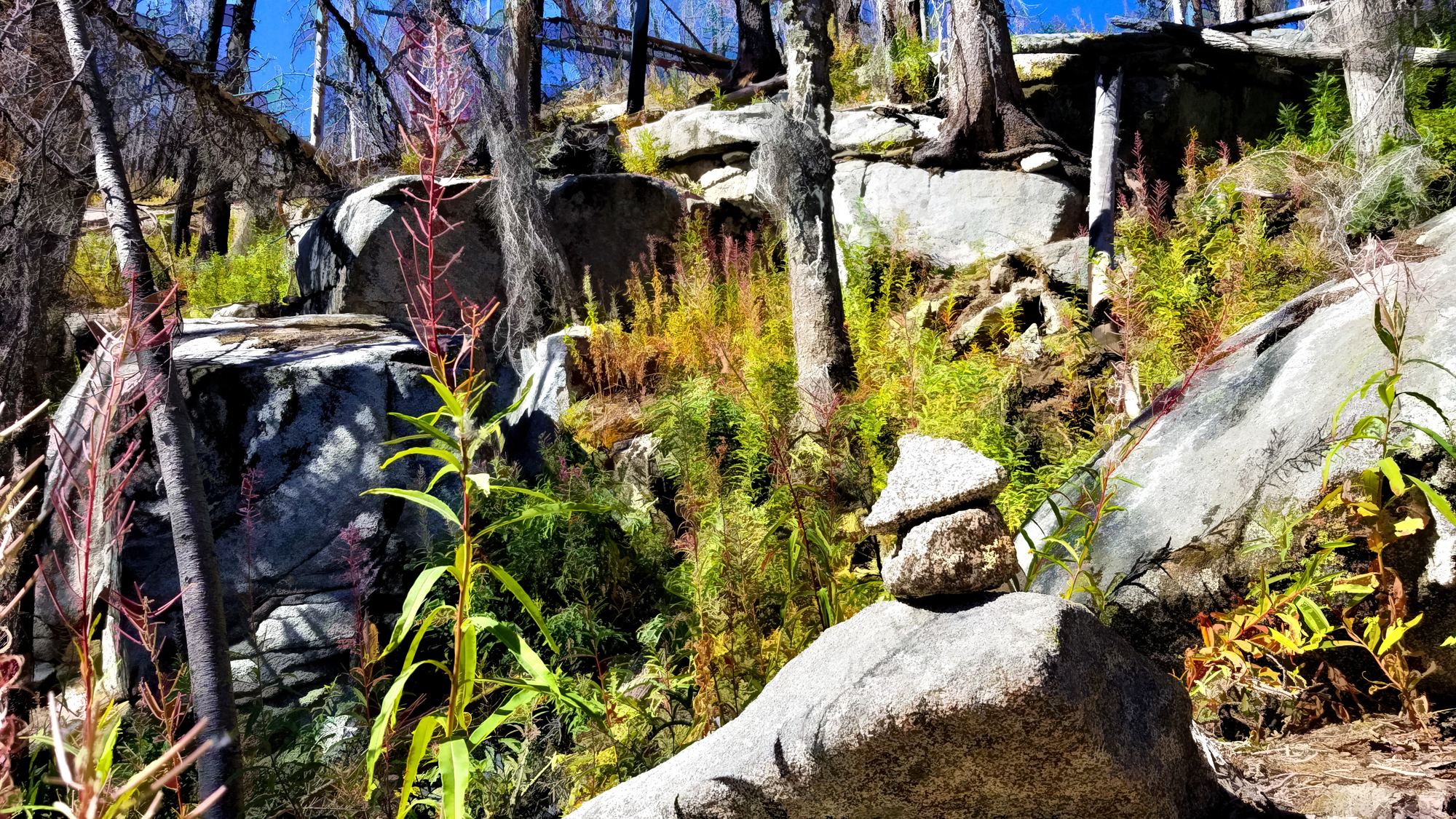
That happened frequently in the lower sections of the approach as we navigated through brush, densely packed trees, and clambered across corrugated rock and dirt ravines, and a series of sloping boulder fields. Our journey was a master class in terrain observation and route finding, looking for, and hiking between small rocks cairns left by previous travelers. Of course, the various cairns might not necessarily mark the best route.

They could be deceptive, simply indicating that someone, presumably climbers, had been in that place before and thought to stack a small pile of rocks on a large boulder to help others, and themselves on their return. Those travelers might be off the route as well. But without a GPS who could tell? There were many and we mostly trusted them for general direction. I thought of naming the place ’Hall of the Mountain Cairns.’ Just an inspiration of the moment. None of the cairns exhibited any artistic rock stacking intent and as such the small piles sometimes presented obscure and questionable messages.

“Is that a cairn or just a rock, or some rocks, that fell onto that boulder?”

The little rock piles were not enough. So, we combined technologies, both Stone Age and Space Age, using both rock cairns and satellite maps to guide us in our sometimes meandering, and at times maddening path. After a mile of some of the slowest hiking I had ever done, we exited the last of the lower boulder fields and found a rough, but distinct, trail. I gazed in wonder, “Who made this trail?” I would only later learn that the trail had once been longer and more visible but many sections had been covered by the scattered debris of massive rock slides, the densely tumbled boulders that we had slowly, carefully hiked across. I found the situation interesting to ponder. Nothing is static in the mountains. Everything is in a continuous state of transition. More than you might imagine.

Now that the path was more visible, our spirits lifted. The weather episodically cleared to present ephemeral glimpses of blue sky and the promise of warmth ahead. Shortly after, the trail shot up with a purpose, steep and loose sections punctuated with tree roots and rocky steps. Hard hiking in those sections. A lot of stop-and-go as we found our way. After some time, the incline finally backed off and we followed a circuitous path through golden groves of larches, often feeling their soft needles as we passed. I felt it a form of reverence to thoughtfully touch them.

We soon arrived at the small alpine tarn that I had envisioned as a potential reflecting pool for the golden trees that massed nearby. My vision was not to be. The tarn’s water had long since evaporated with the scorching heat of summer, leaving only a forlorn and empty bowl of gray rocks and weathered deadfall. There would be no shimmering liquid reflections of golden larches today. I felt the proverbial wind leave my sails as the gray clouds obscured the faint blue gaps in the sky. We stopped, sat on a flat boulder, snacked, pondered our situation, and waited for the skies to clear. I voiced the quintessential PNW question, “Do you think it will burn off? My hiking companion, Peter, replied, “I think so.” Not a convincing answer.

Even though we hiked for the joy of it, I had photographic ambitions and packed my tripod and heavier camera gear to create spherical panoramic images. The extra weight that I bore was always justified by the promise of sensational images ahead. And, without that, what was the purpose of the extra effort? It was always a gamble, mostly with the mercurial weather of the Pacific Northwest. As I felt my spirits sink under the shroud of the oppressive gray skies, an unseen hand of doubt tugged at me. “Should we just bag it?” I asked. Fortunately, Peter was game to continue. His unwavering resolve and the sudden appearance of a partially blue sky reenergized me. It was as if the sky gods had listened and decided to encourage us forward. Yes! We shouldered our packs.

The rough climber’s trail steepened once again and we continued, mindful of every foot placement. Even though I took and used my hiking poles, I found them both equally helpful and a hindrance depending on the situation. So, a draw. On a positive note, unlike thrashing through heavy brush, the steep trail was often open, affording sensational views as we paused to catch our breath, look back, and scan our surroundings. The larches were now prolific, artistically interspersed along the boulder-strewn slopes. The place just radiated pure magic. It seemed to me the finest larch hike that I had yet experienced.

And then, we arrived at our destination, a high mountain pass that gazed over another larch-filled alpine cirque just beyond. I turned off my electronic GPS tracking device, took off my pack, and scouted the area, wandering back and forth, visualizing, and weighing the photographic possibilities. And once I found the right vantage point, I set up my tripod. Now in my happy place, my creative zone, I started shooting. I eventually took images for three panoramas, two at different locations on each side of the pass and one further down on the return trail that crossed an intimate larch grove near the lonely empty tarn. Once satisfied, I repacked my photo gear. It would not do to carry a tripod and camera over a boulder field with often tippy rocks.

Despite the inconsistent weather, it had been a very good day. Reluctant to leave, we turned to descend the steep and often loose trail and then traverse the sometimes treacherous boulders back to the trailhead, all without injury. Tired now, we turned our attention once again to finding cairns. Vast boulder fields stretched before us, all without an obvious path, often terminating at a brushy grove of conifers. Even after a successful traverse, our next steps were usually hidden from sight. We would have to puzzle our way forward again as we thrashed through the dense woods.

So, it was no surprise that we managed to get off route on our return as well. We dutifully corrected our path each time by stopping and referencing my electronic device, the plan B tool. I was so glad to have it. I could not imagine attempting this hike in prior years without it. And even with it, our progress was slow.

With only 100 yards remaining we heard voices and soon encountered two young women playfully walking their dogs, the only hikers we had seen all day. I reflected that while the larch-seeking mobs had congregated at the better-known hikes, we had the joy of savoring this obscure and special place alone. We both felt no small amount of satisfaction in that.

Days before we embarked on our larch quest, Peter told his son-in-law Brian about our plans. Since Brian was an accomplished climber and familiar with the place, I expected to receive some valuable information. That didn't happen. He simply said, “There are better trails.” Not the kind of beta I had expected. Not very helpful at all. After returning to the trailhead, I joked with Peter about Brian’s earlier statement. Peter turned toward me, smiled, and replied. “He got it exactly right.” We both laughed.

As difficult as the hike was, I loved it and am already planning to return next year with Peter and another close friend. Even though I rarely repeat hikes these days, I found it an exceptional place, a standout that deserves a return visit. If you are wondering if I will be posting about it on the Washington Hikers and Climbers Facebook page, bragging about our accomplishment and the astounding beauty of the place, the answer is an unequivocal “NO.”

Will I write an online trip report for the Washington Trails Association like I usually do? Nope. Not going to happen. This environment would not suffer novices lightly. I shudder to imagine how many would get lost and quite possibly injured. Not a comforting thought, and it would not be half as enjoyable with so many others. It is best that they do not know.

You see, I like it just the way it is, remote, rough, challenging, and pristine. There are some places that are worth keeping under the radar. And, this is most emphatically one of them.

Monday, October 9, 2023

Slow Dancing with Deadfall


What type of fun was this? Type 1, 2, or 3? Obviously not Type 1. No one heard me. Only my internal processing mulled that question. I bent down, crouched low, and placed my hands on the crystalline dirt, knees nearly touching the ground, as I tried to make myself small, and carefully scoot under the massive fallen log. I did not like it, but it was necessary, as the dead tree trunk was too high to climb over and too long to hike around in the thick brush. There was only one way, under.

I had to be mindful to avoid the sharp spiky stubs of long-since broken branches. I could get seriously cut up, or even worse, impaled by the damn things, and they were everywhere. To top it off, the bark was scorched black by the fire that had long ago killed and felled the magnificent trees before me. Just brushing against them left black marks that streaked across my clothes. And, this could not be avoided. Close encounters with crusty charcoal. Nice.

If it were only one of a small fallen group of trees, the inconvenience would be of no consequence. But there were hundreds of downed timbers scattered like matchsticks across an unmaintained trail that stretched over a half mile. That rough section would eventually come to an end at an unsigned, obscure, narrow trail. One that would lead us higher, much higher. That would come later. I steeled my patience for the present.

I observed my companion Roy fitfully forge ahead as he often paused, evaluated, sighed, and then decided on up and over or down and under. I took photos of his contortions while I waited for him to cross the obstacle of the moment. I thought our escapade would make for great stories, ripe for embellishment once we returned. The tales we later tell are always the best part of ‘Type 2 Fun,’ lovingly recounted once the hellish parts are over and done. Yes, I decided, this was definitely ‘Type 2 Fun.’ And although I observed his twisting body, it did not help me. My body was different from his, smaller and lighter, and my way through the thicket of deadfall was also different every time.

Surprisingly, I took no small amount of pleasure in the problem-solving event of the moment, both in my movement decisions and the physical gymnastics that followed. I found it akin to dancing as I embraced the opportunity to make my movements as simple and graceful as possible, using the bare minimum of energy to surmount the spiky trunks while I imagined myself hardly touching them at all. I found the burn zone a complex and convoluted outdoor dance studio complete with a dazzling array of required forms. As we puzzled our way ahead, I focused on making my traverse elegant. My way of embracing the difficult task.

Once over the last fallen tree we hardly realized it until we had gone more than twenty feet without another obstacle. While we were done with the burn zone, we knew there would shortly be more difficulty to come. As we continued past a small drainage that fed the boggy reed-filled meadows, the headwaters of Lake Stuart, we almost missed the turn to the hidden trail. Chalk it up to our fatigue and frustration. If not for a group of dead branches casually lying across the path ahead, we would have continued and perhaps become lost. Knowing of these helpful trailside markers, I paused and turned to my right. Was this the place where the trail turns up to a steep ascent that would take us to the shores of Horseshoe Lake?

I stepped forward like an animal picking up a scent, the visual scent of a path ahead. And suddenly, there it was, a narrow twisting path that snaked behind a trailside tree and headed up. There was no sign, other than the previously encountered scattered branches. I have since heard of a horseshoe nailed to a tree but we did not see it. The trailside vegetation was thick and brushy, cleaved with the twisty, rising path of loose dirt and rocks, and punctuated with dusty granite boulders, high angled rock slabs, the occasion spiky deadfall arch, and gnarly tree, both dead and alive, standing tall against a cerulean sky.

If our only purpose was to observe, we would have even more appreciated that we inhabited a rare place, one not often visited, a place of stunning beauty. In those moments we felt fortunate indeed. Nonetheless, we kept moving, focusing on every step. The trail climbed with a purpose and we perspired mightily. We gained over 1,200 feet in seven-tenths of a mile before arriving at the lake. I calculated that to be over 1,700 feet in a mile. Damn steep. And the route finding was often challenging. At times the way ahead seemed to disappear. So, I would stop, scan, and explore, looking for the hidden key, and once found, I would later notice a small rock cairn thoughtfully placed to guide others. There were several and, unlike the self-anointed cairn kickers on social media, I did not knock them over. I observed that although they did not actually help me find the route, they provided validation that I was on the right path. And I appreciated that.

In difficult places, I briefly wondered why I was there. Then stuffing that doubt, I continued up. The obstacles here were different than the burn zone, still requiring a deft balance and use of hands but also the rock climber’s use of friction and edging to surmount the large granite obstacles that at times blocked our upward path. Of course, in this late season, they were dusty. While easier to deal with than mud, the dusty earth still presented a slippery surface and I paid close attention. It would not only be embarrassing but painful to slip and fall off a dusty granite slab. Even a small fall could result in significant injury. Fortunately, I had old rock-climbing skills and knew what I could rely on, my sense of what would go and what would not.

The surrounding soil was not barren. Robust thickets of flowering subalpine plants stood shoulder to shoulder surrounding us and the stark rusticated trunks of the hardy trees. The high-angle meadows were dense with the bright colors of these native plants and the muted tones of rock and bark. We often stopped, not only from fatigue but to gaze in wonder at the diversity of color and texture. We savored the beauty of all that surrounded us as we twisted and pushed up the lonely trail.

Once past the steepest sections, we meandered up through high-angled sub-alpine meadows before the last push to the lake. The terrain steepened once again and we took the last section carefully as the trail was mostly fine loose dirt, a difficult surface with which to find purchase. I made a mental note, thinking about what this surface would require on our descent. And suddenly, we were there. The scene expanded and the waters of the tiny alpine lake sparkled in the bright sun. The pristine panorama held me transfixed, the shimmering lake waters surrounded by granite slabs and weathered trees, both alive and thriving in the thin soil and dead sentinels with cruelly twisted branches reaching awkwardly up towards the sky.

The late-season landscape was now staging an ephemeral transition, the soft needles of the alpine larches briefly turning a brilliant gold before gently falling. Rare twisted Whitebark pines stood beside them. We paused, each absorbing the wild terrain before us. And then, Roy and I separated, each on our own mission to explore and photograph the special place. I saw only one other person, a man we had encountered earlier on the steep trail. There were no selfie-takers posing by the lake. I smiled, acknowledging to myself that if this place was better known and easy to access it would be overrun with such people. I thanked the mountain gods that nearby Colchuck Lake and the Enchantments were the preeminent social media magnets that absorbed them all.

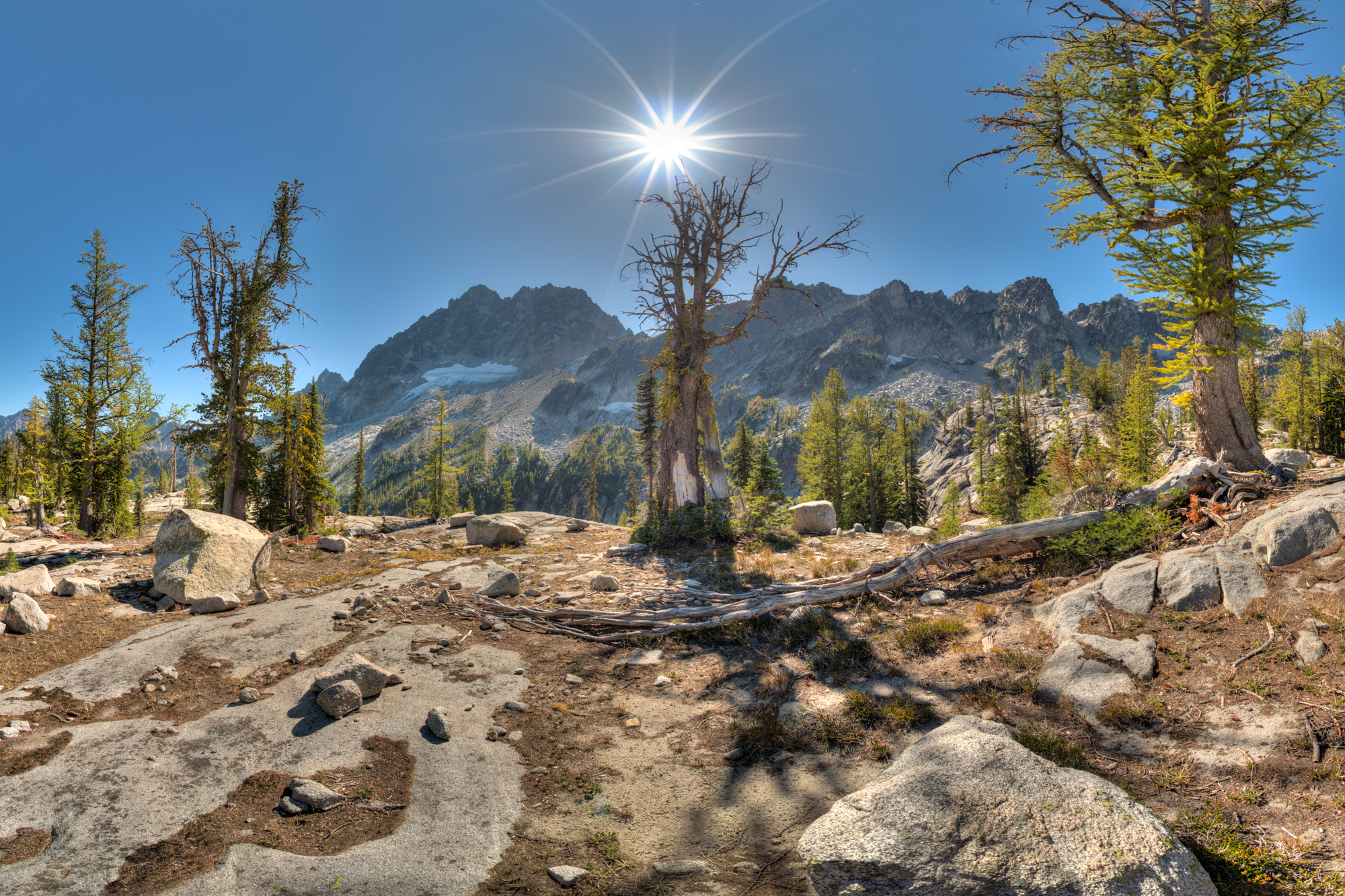
As I wandered the rocky slabs to a knoll above the lake the stark dark gray form of the North Ridge of Mount Stuart dominated the skyline. I paused. I had been there before. I had climbed the technical rock route in my 20s. At that time, the glacier was robust and expansive, a daunting field of snow and ice that we traversed to access the North Ridge. I found myself sad to view its now diminished state, a victim of the ravages of climate change. But I took heart in the beauty of the gnarly trees that stood tall along the granite slabs as they framed the mountain. I set up my tripod, leveled my camera, and took enough photographic images to create a spherical panorama.

Although exhausted by the arduous hike to the lake and the unseasonal heat of the early afternoon, I persevered and took enough images for four spherical panoramas. I knew that I might never return, and probably not again on such a fine day. We had found a rare weather window for our trip to Lake Stuart and Horseshoe Lake. That would be unlikely on any return, or so I thought. While the day was without wind there were also no clouds, my only disappointment. I always wished for clouds as they could provide an enchanting visual structure and sometimes add haunting drama to any landscape, often in the most surprising ways.

Time seemed to stand still as we wandered. And, then, once we reconnected it was time to go. We filled our water filter bottles for the hot retreat. As we turned to depart it was with a mix of regret, the regret of leaving, and measured caution for the descent ahead. While we had been intermittently separated on our ascent, I was more circumspect about our return. Considering the possibility of a fall, I suggested that we stay close together on the steep trail down to the burn zone. Though we both took hiking poles and used them often, we frequently used our hands in the scramble sections. While poles could be useful for providing extra balance, they could be risky on a slippery surface if relied on too much.

I cautioned both myself and Roy not to put too much weight on them going down, especially in sections with loose dirt. It was infinitely better to go slow, breaking any difficult part into small steps and only using the poles to provide the nuance of balance rather than leaning on them. One slip of a weighted pole could produce a nasty tumble. Again, I relied on the physicality of my slow dance to negotiate the way back down to the relative flats of the approach trail. To my relief, we both arrived without mishap.

Yes, the return across the burn zone was as frustrating as our first time through, perhaps more so as we were now tired. I found it interesting to encounter several sections of deadfall that I distinctly remembered crossing on the way in. Some could be navigated using the reverse of the path used on the approach but others required a completely different method as the forms encountered on the return presented new problems yet to be solved. And so, I continued my intently focused dancing.

And once back at camp, I asked myself, was it worth it? My answer came quickly. Yes, it was! And, I had Roy to thank. Though I have my list of mountain projects, Horseshoe Lake wasn’t on it. It had been on Roy’s for several years and I was merely the willing partner in the right place at the right time. He had attempted it a couple years earlier and his partner bagged out. I was glad that I had been able to help him make it happen. It is what we do for friends.

While we completed our journey without any serious injury, we discovered our legs freely bleeding from all the scrapes. I retrieved my first aid kit and broke out the Neosporin and Band-Aids. Given our cut-up shins, I rated the route a 2.5 on the fun scale at the time. I laughed. Was there such a thing as 2.5? That was cutting it fine I thought. I had been in far worse situations so it most definitely did not rate a 3.

Now, several days later, at home and having processed my photos I am wistfully romancing the place, the journey, and my memory of it. I have revised my score. No, it is not a 2.5. It was better than that. I now deem it ‘Type 2 Fun.’

Why did I back off from my earlier and harsher evaluation? Because now I already want to return. And that is a key part of the definition of ‘Type 2 Fun.’ You might be having a miserable time during all or parts of the experience but in retrospect, it does not seem so bad. With this passage of time, I find the magic of the hike and the lake now enhanced in my consciousness and the prospect of a return very compelling while the suffering parts of the terrain have now slowly receded in my memory, becoming more of a story than a reality.

I later reflected on the contrast between the fierce wildness of the terrain that led to Horseshoe Lake, a robust natural orchestra of twisted forms, with surfaces both hard and soft, and yet the subtle beauty of each plant, tree, and boulder that seemed to so zealously guard access to the pristine waters above. The rough, unruly, enchanted gardens arrayed before us were truly the gates to an alpine heaven.


PS: Here are links to two of the spherical panoramas I took on this hike. I find the images mesmerizing and I think you will too. They are available for viewing at 360Cities.net via the links below. For the most immersive experience, click on the ‘Toggle Fullscreen’ icon in the panel in the upper right of the onscreen image. Then scroll to savor the views.

Treasure Island, Horseshoe Lake, Alpine Lakes Wilderness, WA: https://www.360cities.net/image/treasure-island-horseshoe-lake-alpine-lakes-wilderness-wa

Mount Stuart, Horseshoe Lake Overlook, Alpine Lakes Wilderness, WAhttps://www.360cities.net/image/mount-stuart-horseshoe-lake-overlook-alpine-lakes-wilderness-wa

Sunday, September 3, 2023

Passing the Torch

Mark referred to his young sons as the ‘cubs.’ That fit. As a seasoned alpinist who had once ascended Ama Dablam, climbing the final summit pitches solo, he had adopted the shy and elusive Central Asian snow leopard as his spirit animal. That day in June, just five years ago, his sons Chase and Tyler were eleven and thirteen. Nonetheless, the ‘cubs’ moniker still seemed right as they rapidly ascended the steep and rocky trail on Bandera Mountain, both quiet, nimble, and quick.

We had come for the Beargrass super bloom and the expansive alpine views. The creamy white blossoms blanketed the steep alpine meadows but the day was densely foggy and offered no vistas. The Beargrass was magnificent, but the gray shroud of mist dampened our spirits. We sat on the summit of Little Bandera and ate our snacks in silence. While the cubs seemed to enjoy the hike, it was hard for me to gauge their enthusiasm for more. They too seemed shy and elusive.

Our next adventure took us even higher to cowboy camp under a clear night sky with brilliant starlight and a robust meteor shower, the famed Perseids, streaking overhead. Tyler had a previous commitment but Chase, now a year older, accompanied his dad as we trudged up the trail to the Granite Mountain Lookout. Mark and I had heavy packs, me with ten pounds of camera gear, and Mark with all the fixings for a gourmet camp meal, his savory smoked chicken sausage stew. I knew our hike would be a grind as I had been there many times before with a lighter day pack. Even then, it was always an ass-kicker. We arrived, feeling spent. The strenuous effort was soon forgotten as we settled in, made camp among the summit boulders, wolfed down dinner, and waited for the light show.

Chase explored the jumbled granite world of the spacious summit, energetically jumping from boulder to boulder and sometimes turning back with a smile. His enthusiasm was contagious. As the light departed the day, we added layers, and the cold and starry night enveloped us. Mark and Chase laid back on their sleeping pads perched on granite boulder recliners as I manned the camera in my first attempt at capturing the Galactic Core of the Milky Way. It soared above us as it arched over the eastern shoulder of Mount Rainier to the south. The fire lookout tower framed it on the other side making the dramatic composition I had envisioned. Once finally satisfied, we snuggled into our sleeping bags and looked up at the ancient lights of countless stars. We felt the wonder of it all as we drifted into dreams.

The next day dawned a brilliant golden orange as the sun crept over the eastern peaks. I took a few more panoramas in the saffron light before breakfast. We ate silently, all remembering the night. With some regret, we packed and departed. As we descended the rocky trail, we encountered over a hundred Saturday hikers coming up. It would be crowded at the lookout today, but last night we had it all to ourselves. As we headed toward the trailhead I briefly thought of Tyler and wished that he had been able to join us as the whole experience, which I called the “Granite Mountain Galaxy Quest” had been pure magic. Of course, there would be other future hikes to share. So, I thought.

But in 2020 there were none. COVID-19 held court and I hiked solo, discovering my aloneness.

Last year, I finally resumed hiking with Mark, and the cubs, soon to no longer be known as the cubs. We embarked on two epic adventures, the first a failure and the second a success. Mark had long wanted to return to the Picket Range and climb Luna Peak. Since we were in the business of helping each other realize our alpine dreams I quickly embraced his vision. It became mine as well through the process of planning each section of the journey. One thing was clear from the outset. It would not be easy.

Our mission to Luna Peak was to experience the ethereal summit views of the dramatic surrounding peaks of the Northern and Southern Pickets. Instead of a quick trip, we decided to take five days. I called our schedule the Luna Peak SKT (slowest known time). We'd hike to Luna Camp on day one, ascend to Access Creek Camp on day two, summit Luna Peak and return to the high camp on day three, descend from Access Creek Camp back to Luna Camp on day four, and hike out on day five. It was a good plan. It seemed easy and doable from my desk at home. But like so many mountain adventures in the North Cascades, the plan did not survive the second day. It simply blew up.

We left my house at the crack of dawn and drove to the Marblemount Ranger Station to pick up our pre-reserved Luna Camp permit. We arrived around 8:00 a.m. to find a host of hikers milling about, waiting for walkup permits. It was a ‘please take a number’ situation, literally. So, I took a number and waited. The time cushion from our early start was evaporating. We had a 9:45 a.m. water taxi reservation at Ross Lake.

When we got to the Marblemount Ranger Station permit desk the ranger asked if we had ice axes and helmets. We did not. The young ranger frowned. GPS and/or locator beacons? No. Another frown. Bear cans or bags? Yes. Finally, a smile. Had we bushwhacked before? Why yes, we had. Another smile. Did we bring blue bags? No. Another frown. So, the ranger gave us enough for our party of four for two nights at Access Creek Camp. I assured the ranger that we had long mountaineering experience and would not do anything stupid. She smiled and handed me our permit. The process was impressively thorough but chewed up more time than I had anticipated.

We left intent on hauling ass from Marblemount to the Ross Lake parking lot. It would not be as we had imagined. At mile 134, we encountered three separate road crews working on repaving. Why now, I thought. Good weather, of course. Three stop-and-wait situations occurred, all with a slow drive following the lead truck through each of the one-lane sections. More time evaporating. A nail-biter. We finally got to the Ross Lake parking lot and found what looked like the last available space. We shouldered our packs and sped down the one-mile trail to the lakeside dock.

The boat finally showed up at 10:00 a.m. We loaded our packs and climbed in. With 250 horsepower, the water taxis again hauling buns, the first of the day. A feeling of exuberance enveloped us all as we sped towards the Big Beaver dock. We exchanged broad smiles. The trip to Big Beaver Camp and the start of the Big Beaver Trail took only 10 minutes. We disembarked, took a group photo, and started up the trail.

That Wednesday and Thursday were forecast to be around 90 degrees so we wanted to make time in the morning before the day really heated up. Fortunately, the early part of the day was reasonably cool. The plan was to continuously hydrate and eat snacks during a single push on the 10 miles to Luna Camp. As we hiked the long approach toward Luna Camp, the day grew measurably hotter and the last miles to camp were brutal, even with relatively light 35 lb. packs. We perspired mightily as pesky bugs swirled around us. The ‘cubs’ took it all in stride.

Once at the Luna Camp signpost, we descended the spur trail to find two tent campsites and a single campsite for horse campers, all spread far apart from each other. We picked one, pitched our tents, and settled in. The local bugs arrived on cue and tormented us as we tried to relax and make dinner. Even so, the insect’s attacks could have been way worse. And, the air was still and without rain, a blessing The camp toilet location was well signed. An open-topped wood box looked out over a forested area thick with fallen timber, truly a room with a view. The nearby water source was a free-flowing creek with a shallow pool which we used to wash and cool our sweaty bodies. We ate dinner quietly, anticipating the next day, bound to be even more difficult.

We planned to rise early, get on the trail, and find the brushy backcountry route that left the Big Beaver Trail and descended to the water crossing. Once across the swiftly flowing water, we would ascend the intermittent climber’s trail on the north side of Access Creek which would lead us up to the open basin near the headwaters to Access Creek Camp, the area from which we would finally see the cathedral-like silhouette of Luna Peak. The second day’s objective looked like about 4 miles and 1,600 ft. of elevation difference. We expected to travel slowly as there was no established, well-signed route from the Big Beaver Trail. It traveled through the brush, and an obstacle course of fallen trees, to the shoreline of Big Beaver Creek. And once there we might find a friendly log to cross, or not. And if not, we must wade. A successful crossing depended on the right log and/or a wadable section. While it was still the approach, it stood out as the crux section of the whole trip. The crux appearing on the approach was not that unusual in the Pickets.

That morning we headed up the trail, cautiously confident that we would be successful. After all, we had many years of mountaineering experience among us and had read all the beta that we could find from Peakbagger.com, SummitPost.com, and WTA.org. Most reports suggested heading 1.5 miles up the camp marker and then plunging into the brush and making your way down to the water. The problem was that the dense brush was composed of small confers, Devil’s Club, and a continuous thicket of large fallen conifers, a practically impenetrable mess. Once there, a shoreline search for a crossing would occur. Some travelers reported finding convenient logs or wading reasonable sections, while others searched for hours to find a way to cross. The situation was always changing. Whatever we expected, it would be different.

We had met a couple of departing climbers on day one who had successfully completed their ascent of Luna Peak. As we suspected, they confirmed the presence of negligible snow and no need for an ice axe. They suggested leaving the trail at 1.1 miles up from Luna Camp. They also mentioned a faint trail near a fallen tree. I did not burden them with more questions as they seemed in a hurry to depart. I noted later that I should have asked them to describe the fallen tree so that I might distinguish it from the hundreds of others. What fallen tree?

We hiked much further than 1.5 miles on the main trail and yet found no indication of any climber’s trail to the water crossing. So, we backtracked and tried crossing through the brush at the 1.5-mile mark. It was an arduous undertaking and so distant from the creek that we turned around and went back to the Big Beaver Trail. We hiked down and tried again at 1.1 miles, without success. The cubs made several recons and while I worried about them when they were out of sight, they always returned. They had found no accessible crossing. Those unsuccessful forays into the brush and thick debris of fallen trees sapped our collective energy.

We headed back to a point where we could finally see the distant creek. It was less than a mile from Luna Camp. Now, even more bereft of confidence, we decided to make another quick recon, leaving our packs by the trail, and making an unencumbered bushwhack to the creek. Once there, a steep bluff overlooked the shore. We noted a crossable log and another two upstream that were higher above the water and narrower in diameter. The creek was flowing fast and deep enough to negate wading. We sat and meditated just watching the swift water and forest thicket ahead. Now what?

We had burned up more miles and time than reasonable to get to the water. But worse, the flailing effort had seriously eroded our confidence. Mark said, “So, we get to the other side. Then what?” Our failure to navigate this one short section had germinated significant seeds of doubt that we would do any better on the other side. After some consideration, we found that none of us wanted to hike back up to get our packs, thrash back down through the brush, cross the log, hike into more brush, and get completely fouled up, and completely lost. Or worse. I had already fallen backward off a large log during an earlier traverse. Fortunately, without injury, but could we count on that going forward? I had a map and compass, but there was not a GPS among us, so, we were a bit light on precision tools for navigating the brush with any confidence. Our motivation now depleted and with no universal agreement to proceed, we bagged our quest.

Were Mark and I disappointed? Hell yes! And, we were completely dumbfounded that we had not easily found the right path and crossed the creek. That had never happened to us before. We trudged back and settled in at camp and had dinner with the mosquitos and black flies, our penance. At least we had plenty of wine. Mark and I briefly grumbled about the day as we ate, yet we looked forward. The cubs wisely stayed silent. Always resilient, we conjured up a consolation plan. We would hike out, catch a water taxi, and head to the Thornton Lakes Trailhead, hike in, and summit Trappers Peak. We so needed to seize victory from the jaws of defeat. Yes, that would help us feel better. Absolutely!

The next day we hiked out, just missing a drop-off water taxi by 20 minutes. After waiting for three hours, the taxi finally showed up again at 4:00 pm and we sped back, a light rain now splattering on the windshield. After 10 miles on the Big Beaver Trail, we were not looking forward to that last uphill mile from the dock to the parking lot. The ‘cubs’ took the entire arduous effort, failed attempt, and retreat, quite well. I heard not one complaint or disparaging word from either of them. Even our defeat seemed an adventure to them. I noted that and was impressed with their graceful composure.

We trudged up, loaded the car, and drove away to search the nearby campgrounds for an overnight tent camp. All were full. It was Friday evening after all. Nuts! We left the North Cascades, returning to home base after a brief stop at the ‘Burger Barn’ in Darrington. As we wolfed down the savory burgers and fries, we resolved to come back, not for Luna Peak, but to summit Trappers Peak. The magnificent summit hosted sensational views of the Southern Pickets, vistas not to be missed. As we drove back, I reflected that there are thousands of these failure and redemption stories in the North Cascades. Our story was only one of many, and yet uniquely ours.

After our self-perceived ignominious defeat on the Luna Peak quest, we had to come back. If we could not gaze in wonderment at the spiky spires of the Southern Pickets from the north side, perhaps we could view them from the south side. Our earlier solution, to summit Trappers Peak and look north still held promise, a simple plan that renewed our hopes for a successful venture. Visions of granite peaks enveloped us as we envisioned not only the Southern Pickets, but also Mt. Triumph and Mt. Despair, and the three Thornton Lakes, all tiered in ascending rocky alpine bowls.

The trailhead to Trappers Peak is a long drive from the Seattle area for a day hike. I had done it before but did not look forward to that approach. Perhaps we could camp at Thornton Lakes and summit on day two? Fortunately, we could not get a Thornton Lake camp permit which led to a much better solution. We scored the single remaining available reservation for a walk-in tent camp at Newhalem Campground. It was perfect! A gift. Easy car camping and the Thornton Lake Road, the trailhead access road, was only minutes away.

We set our tents, settled in at the campsite picnic table, and carbo-loaded with Mark’s spaghetti with meatballs and a tasty Argentine Malbec. And, wonder of wonders, very few bugs! After dinner, we pulled out various maps and planned future trips. Our mood was auspicious. Our energy was renewed. The route tomorrow would require no bushwhacking. We slept that night with summit dreams.

The air was cool and the hike along the decommissioned forest road went quickly. After the second mile, the trail got down to business, ascending about 1,850 feet in the roughly 2.35 additional miles to the trail split post for Thornton Lake and Trappers Peak. I reflected that just looking at the stats does not adequately convey the difficulty. The woodland terrain is a veritable rock and root fest. The kind of trail where you spend a lot of time looking down, both ascending and descending. After another picturesque creek crossing at about 3.75 miles, just prior to the National Park signpost, there was an opportunity to filter more water as the trail up to Trappers Peak soon emerged into full sun and would get baking hot. A subsequent signpost announced the trail split to either Trappers Peak or Thornton Lake (the lower of the three) at 4.55 miles and 5,050 ft. elevation. We continued up.

Ascending Trappers took another roughly 0.8 miles from that signpost and 900 plus feet of additional elevation gain. Again, the stats minimaxed the effort, some of our ascent on an easy-to-follow trail with intermittent sections of steep scrambling. The crux scrambling section came at about 5,350 ft. The steep rock pitched upward against a granite wall on the left. The route narrowed into a chimney-like formation. Fortunately, there were several sturdy tree limbs on the right, easily available to grab onto. Always faster than me (I was carrying the heavy camera gear), Mark and his sons had waited above the chimney. As I prepared to climb it, Tyler descended and offered to assist by taking my pack. I had not considered needing his help as I had climbed this section on a previous attempt, but I thought accepting his kind offer was a good idea. He shouldered my pack and we both resumed. Mark later hefted my pack and declared. “It’s heavy.” Tyler replied, “But it’s comfortable.” What a guy!

Once past the crux, there were still a couple of steep sections with some exposure. One a short traverse along a narrow granite rib with considerable exposure on both sides. Highly motivated, we all watched our feet, ignoring the exposure, crossed the rib, and continued to the summit. On arriving at the top, we were exhilarated to witness a magnificent panorama of spiky peaks surrounding our summit. Drifting clouds alternately obscured and revealed each one. A dynamic visual alpine opera drifted before us. The rugged panorama held us speechless. I thought of my favorite superlatives. They all applied. And then some. Simply jaw-droppingly beautiful!

As I set up my tripod to shoot photographic images to make spherical panoramas, I noticed the weather was changing. I had pictured an array of clouds to provide visual structure but there were far more than I had envisioned, the sun at moments peeking through and at other times obscured by the enveloping clouds. It was yet another situation where I realized that I could not art direct nature. I accepted the gift of the present and moved forward. The summit peaks of the Southern Pickets were shrouded by the drifting white mist, yet the east face of Mt. Triumph jutted proudly before us. Upper Thornton Lake, ensconced in a steep granite bowl, still had ice on the surface. Completely entranced, we stayed, snacking, exploring, and photographing for an hour and a half before heading down. None of us wanted to leave.

But before our departure, I asked for everyone’s attention as I stood before Tyler and Chase and unfolded two sheets of paper. I read from them, addressing each individually, and inducted them into the Analogue Mountaineering Alpine Club, a society that I founded three years prior to honor the alpine accomplishments of old mountain companions. That day at our Colchuck Lake camp I inducted five founding members, all old farts, myself included. It was both a humorous send-up and a serious acknowledgment of our long friendship and shared mountain quests. I felt the summit of Trappers Peak was the appropriate place to induct two new members and that day Tyler and Chase became the youngest. Each received a document of their induction with the club crest and motto. Their ascent that day was no small accomplishment, one that I thought worthy of recognition. As I read, I was pleased by their satisfaction in that symbolic moment.

Our journey to the top was more physically challenging than the numbers suggested, a 10.6-mile round trip with 3,500 feet of cumulative elevation gain. On our way back to the trailhead Tyler approached me and said that he hoped to still be active in the mountains when he was 74. That of course was my age at the time. I was both surprised and touched by his comment. Both Tyler and Chase loved Trapper’s Peak, vowing to return someday to share it with friends. You cannot beat that for an endorsement.

I had become charmed by Mark’s sons, so capable and yet quiet and acutely observant, always evaluating, learning, and moving forward. I had seen Mark’s videos of their athletic prowess on the basketball court and was amazed at their virtuosity. Their speed, stealth, and dance-like movements routinely outwitted their taller opponents. Most notable was their keen intelligence, and their openness to learning new things. I thought it was due to their acute powers of observation. It was no surprise that they were superb outdoor athletes as well. Another year passed.

This year, Mark seemed determined to summit The Brothers, the higher south peak, Mount Edward. Since he lives on a bay that overlooks the Olympic peninsula, he gazes at the twin peaks every day, and that fed his obsession. Having climbed The Brothers in his youth, Mark now longed to share the summit with his sons. He invited me to accompany him to recon the climb before inviting Tyler and Chase. At first, I eagerly agreed to join him. However, after researching the route and terrain, I declined. It looked like too much unsavory territory to cover in quest of a summit, both on the approach and the climb itself. I called him and said so.

“My dear friend, I really want to do this for you, but I really don’t want to do it for me.” I waited a beat for his response. He understood and let me off the hook. Relieved, I thought no more of it until I had returned from a recent solo ascent of Mount Defiance and received a text from Mark. He and the boys were heading up to do The Brothers. I paused in thought and then wished them luck and a safe climb.

During the days of their climb, I waited and worried. Though they were all very fit, I thought the physical nature of the objective would push them to the limit. And, it did. The hike up and past Lena Lake through the Valley of the Silent Men to the climber’s high camp was a deceptively routine event if you overlooked the sometimes-challenging route-finding and an active hornet’s nest right on the trail before the high camp. They reached the climber’s camp after 6.5 miles and 2,500 feet of elevation gain and settled in for the night. So far so good.

They broke camp at 7:00 a.m., traveling light. Unfortunately, the summit day was an unseasonably hot one, one that would exact a price. They soon encountered another trailside hornet’s nest, followed by a steep and arduous ascent through rough terrain, and up loose rock with route-finding issues thrown in. They climbed higher as a relentless sun beat down. To his surprise, Mark’s hamstrings both suddenly seized up very near the summit, only 500 vertical feet away. To his consternation, he discovered he could not climb any further. Tyler and Chase conferred with Mark and a decision was made. The brothers continued up while their dad waited and worried. After an hour and a half of fretful anxiety, he looked up to see Chase energetically waving from the summit. The cubs had made it! It was no small feat as another group of seasoned mountaineers had missed the final key to the summit, a narrow chimney, and had abandoned close to the top. Mark felt both pride in their accomplishment and yet significant concern for their safe descent.

The upper slopes were steep loose and ripe for a fall. As Mark watched, he could have imagined his navigating it for himself. It was not comfortable. When his sons finally rejoined him, his relief was palpable. They carefully made their way down the balance of the steep scree. Finally, near the camp, they again encountered the upper hornet’s nest. Although passing the nest with care, Chase still received two stings and ran like a bandit down the trail as the determined insects pursued him. Once back at camp they rested briefly, packed, and departed. They soon braved a thicket of Devil’s Club to circumvent the lower hornet’s nest. It was a tossup, stinging nettles, or stinging hornets. A no-win situation. Nevertheless, they soldiered on down those last interminable miles of trail to the car, arriving completely thrashed.

It was only later that the boys shared with Mark that they were at times scared during their ascent and descent. They had undoubtedly approached their limit, but with their youthful stamina, athletic capabilities, and perceptual intelligence, succeeded where others had failed. When Mark later called to tell me their story, I listened thoughtfully said I was relieved by their safe return, and joked with him that this trip was indeed an epic beatdown, true Type 3 Fun. No small accomplishment. He agreed.

As I reflect on Mark, his sons, my recent time with them, and their alpine accomplishments I realize that our adventures with Tyler and Chase in the mountains have been a form of mentorship. It is sometimes a subtle thing as we pass on our experience both by the projects we undertake, how we plan, the decisions we make, and what we achieve in the alpine, and yes, also our missteps, our outright mistakes, and how we handle them. Nothing is hidden, everything is revealed. It is for the young alpine acolytes a meaningful coming of age.

I am now far older than when I embarked on my first alpine quests and so must temper my ambitions with the stark reality of my age and physical limitations. I think about that for my older companions as well. I joke with Mark that we must heed our personal ARC, ‘Alpine Reality Check.’ The way it is when we sense that our alpine time is limited and we mentally prepare to leave the stage. As for Tyler and Chase, while they have a decent alpine foundation, they are just getting started, and their future is bright. When I think of them and the symbolism and fire of mountain dreams, I like to feel that in some meaningful way, I have played a part in passing that torch.


PS: I took my tripod and captured multiple images to create some 360 spherical panoramas on the summit of both Granite Mountain and Trapper’s Peak. Here are links to two. I find the images mesmerizing and I think you will too. They are available for viewing at 360Cities.net via the links below. For the most immersive experience, click on the ‘Toggle Fullscreen’ icon in the panel in the upper right of the onscreen image. Then scroll to savor the views.

Granite Mountain Dawn Patrol: https://www.360cities.net/image/granite-mountain-dawn-patrol-alpine-lakes-wilderness-washington-state-usa

Trapper’s Peak, Summit Vista: https://www.360cities.net/image/trappers-peak-summit-vista-north-cascades-national-park-wa-state

Photo credits to Mark Valdez for the shot of me on Trappers Peak and his sons on The Brothers.

Sunday, August 20, 2023

Cairn Kickers

Last year, I joined the Washington Hikers and Climbers Facebook group as it sounded fun. That was before I realized the group was overrun with selfie-takers who mostly favored hiking Mailbox Peak, Colchuck Lake, and The Enchantments. Anyhow, I thought some of my alpine ink and pencil sketches might be of interest and submitted a few. I particularly liked one of a cairn on the ridge above Maple Pass. I found the form striking. I was taken by the sculptural quality of it and the way key rocks pointed due north. I submitted my pencil sketch and was denied by the group administrator. He complimented my drawing but stated that they discouraged rock stacking and so he would not approve and post it. End of story.

What? Rock stacking? I had not thought much about it before that judgment as I had never in my wilderness travels encountered a collection of numerous decorative stacked rocks, like the ones in photos posted by the cairn haters. They seem to be abundant in places like Yosemite but not in the Cascades. In Washington’s mountains, I have mostly encountered only single cairns, some more dramatic than others. As a former architect and designer, I could usually appreciate the drama of a well-built cairn, er…, a well-built stack of rocks.

I have recently noticed significant editorial pushback against rock stacking and a clarion call to knock them all over. According to those who endorse kicking cairns, a decorative stack of rocks is the mark of human disturbance, and a visual distraction amongst untouched nature, which should be knocked down. They also state that the practice disturbs the soil and disrupts the habitat of small creatures that call them home. A recent news article from the Yosemite Park Service encourages hikers to stop building large rock towers and dismantle any they find. A Facebook group called Cairn Kickers International (Major League Cairn Kickers) states: “Cairns are a blight upon the Earth. Help us cull the herd.”

So, what sets the various types of cairns apart? What is the determinant of what is worthy and what is disruptive and not worthy? It is generally agreed that the most useful and appropriate application for rock cairns is to provide a navigational aid, to guide a hiker up a sometimes-indistinct trail, or to find the branch in an elusive unmaintained climber’s trail. Sounds reasonable to me as I have found those types useful. In fact, I might prefer them to the fluorescent surveyor's tape I recently encountered on the aggravating upper sections of the Rachel Lake Trail.

The steep, loose, and rocky route up from Colchuck Lake to Aasgard Pass is a prime example of an indistinct trail as it occasionally branches into meandering braids and sections where it is easy to get off route and into even steeper, more treacherous, terrain. There are occasional navigational cairns and rock stacks, which many hikers might find useful for guidance. But even on the path to Aasgard, the discernment between useful and ornamental gets tricky. If the cairn is not big enough to be noticed it serves no navigational purpose. If it is too big it may be judged decorative and offensive, a desecration of the natural world. So, where do we draw the line? What gets kicked over and what does not? My photo shows a larger-than-average cairn partway up to the pass. Should it be knocked over or left to guide?

The minuscule trail markers for Alta Mountain and Dirty Harry’s Museum trails are good examples of the more modest trailside rock piles that alert you to the trail branch that you will want to take toward your objective. Otherwise, you might easily hike right on by and find yourself later backtracking to find the turn-off. They are only small piles and clearly not decorative. Do they deserve to be kicked and scattered?

When we summited Alta Mountain back in 2021 there was a large rock cairn at the rocky summit. I liked it for its visual drama and the fact that we could see it far down the long ridgeline as we ascended. It was navigationally functional as it let us know exactly where the summit was and how much further we had to travel. We sat next to it as we had our alpine lunch and admired the distant views. I photographed it and later sketched it.

While I did not critically evaluate it at the time, I thought it deserved to stand. In reading recent WTA trip reports I noted with some disappointment that it has since been knocked over. I question the utility and wisdom of that action as it seems yet another disturbance with no value added. And who gets to decide? Who is the arbiter of what should stand and what should fall?

When I see photos of a veritable rock garden of a large group of cairns, a clearly excessive display of rock stacking, I can agree that they should not be there and warrant knocking over. Perhaps a single vertical rock stack on the rocky slopes surrounding an isolated lake in Gothic Basin is more decorative than navigational and should arguably be dismantled. But who decides? A former hiking partner told me that for years he routinely knocked over every cairn that he came across before finally acknowledging to himself that perhaps some provided navigational value and should be left as is. He has long since left the judgment game behind and now just passes by the mountain cairns he encounters.

But what about the single stacks of rocks on barren, rocky terrain that are both directional and decorative? I think back again to Gothic Basin in October of 2018. When hiking across a series of expansive, fractured rock aprons, I came across a carefully balanced stack of rocks about four feet high. To my eye, it stood out but not in a bad way. Was it navigational, decorative, or both? I could not tell, but I liked it. I set up my tripod and took photographic images to create a spherical panorama with the cairn as a foreground focal point. You can see it here. Gothic Basin Near Gothic Pass: https://www.360cities.net/image/gothic-basin-near-gothic-pass-north-cascades-wa-state-1

And, later, during our departure from Gothic Basin, I encountered two smaller artfully balanced rock cairns, one with three rocks and the other with only two. We descended past them on our way back to the main trail as we left the basin for the long hike back to the trailhead. Again, were these rock creations navigational, decorative, or both? They seemed both and I liked them enough to photograph the pair and later sketch them. Did their presence subtract from my wilderness experience? Not in the slightest as I deemed them a rare discovery and useful as they validated our path. 

So, I have been dancing around this issue for way too long. What is my takeaway anyway? It seems that any cluster of cairns, or rock stacks if you will, are highly suspect, especially if they serve no directional purpose. If they have no raison d’etre, gently knock them down. Scatter their components in an artful fashion as if they never were. If they are singular and point the way, warn of cliff precipices, or signal a waypoint, or a significant terminus. Leave them be. If they are stunning in their artfulness, you have now arrived at the point where you should make a considered decision. If you are in your artist's frame of mind, perhaps you could carefully examine their form, reflect on the intention of their creator, take a photo, and sketch or paint their representation later. And, of course, leave them standing. After all the cairn police are not likely to charge you for respecting beauty.

Going forward, as that is the only direction I have, I will evaluate each encountered cairn more closely but will probably leave the knocking-over routine to someone else.


Old Trophies

What is it about trophies? Well, they have more expansive dimensions and weight than a paper certificate. We can gently cradle them in our h...

Beers in the Stream