Friday, November 26, 2021

Mountain Meals


As we turn our thoughts and efforts to holiday meals and time with friends and family, I reminisce about those other holidays, the ones we share in the mountains. After all, any time in the mountains is a holiday, and it’s always better with friends and hearty camp cuisine. In the opening photo, Peter Hickner sautés marinated steak as Mark Valdez anticipates the meal ahead, transfixed by the intoxicating fragrance of sizzling juices and tender garlic. The magnificent granite spires of Dragontail and Colchuck Peaks watch over us.

On that day, five of us from our old tribe gathered at Colchuck Lake on September 25th, ready for a new moon and a chance to see the Galactic Core of the Milky Way arc over Colchuck Peak. And in our plans for our five-night rendezvous, each of us was to be a master chef for a day as we vied to create our vision of mouth-watering outdoor cuisine on our designated night. We were inspired on this trip to celebrate and please each other.

And on our first night, we savored Peter’s tasty dinner, which I subsequently named ‘Marinated Steak Argentina.’ His savory creation was served with sauteed bell pepper and green beans atop a toasted tortilla, and of course, accompanied with a well-balanced Malbec, and later, the smooth bourbon of Basil Hayden. A fine opening meal indeed.

The next evening, Mark made his signature ramen and smoked turkey sausage stew with celery and carrots. It was a meal he introduced me to on another Milky Way galaxy quest, just two months earlier as we bivouacked among the boulders at Granite Mountain Lookout. So tasty at dinner, we had it again for breakfast as the sun crept over the eastern ridges.

We did not dine on freeze-dried meals. Those recent scratch-made meals reminded me of those we made so many years ago when we ventured into distant mountain ranges for days on end. Seattle’s Pike Place Market served as our meal provisions commissary for the specialty items in our larder. While we could get various powdered drinks, Kool-Aid type fruit drinks, iced tea, and Milkman just about anywhere, the same could not be said of the food items that provided the substantial fuel and sustenance for lengthy mountain journeys. 

Fortunately, my early mountain companions were well experienced at this kind of sourcing, procuring links of landjeager sausage (a German-style smoked semi-dried pork & beef sausage) and beef jerky at Don and Joe’s Meats. And from the next stall over at Pike Place Fish (where they are famous for throwing large salmon from the iced displays to the sales counter) lengthy strips of amazing smoked salmon jerky. With ingredients like these, we did not lack flavor.

The various dried fruits and fruit leathers all came from other small specialty shops in the market. We also packed dried ramen noodles, tomato paste, tins of sardines, and smoked mussels in olive oil, instant oatmeal, Wasa Brod crackers, Sailor Crackers, a fruit, nut, and candy gorp. The trick was to keep meals and snacks simple, nutritious, and reasonably interesting for however long we traveled, sometimes up to two weeks.

Meal making with our little blowtorches, the MSR Model 9 gas-fired stoves, could be a sometimes-frustrating experience, but we made do, even finding ways to fry up fillets of mountain lake trout, breaded with cornmeal and herbs. And when the newer WhisperLite model arrived, with a burner more suited to simmering, everything got even easier.

The mountains make each meal unique, the time of day, the expansive, starkly beautiful venues, the ever-changing weather, and treasured hardy companions. The unifying theme is that we’re all so glad to be together, sharing a meal in those special places, dining on the rocks in the halls of granite mountain kings.

Friday, November 19, 2021

The Lookouts

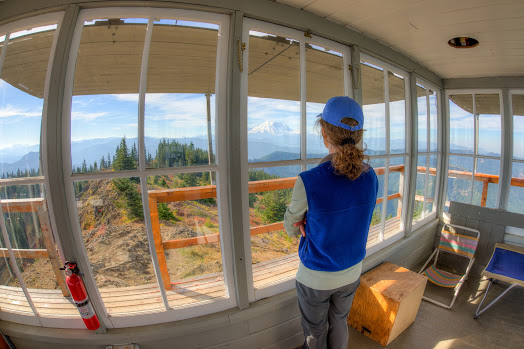
For me, there is something completely magical about visiting a historic fire lookout. Although some are not too difficult to hike to, many require driving up terrible forest roads and hiking arduous miles up, up, and up to reach their summit perches. The effort however is all worth it because the destinations deliver stunning views that will take your breath away. And being there is a reminder of a more romantic past that represents an era before modern technology when solitary human beings dutifully scanned for signs of developing wildfires from austere glass-walled cabins perched on rocky mountain summits throughout the Pacific Northwest. 

“It was a great life. You woke up to the greatest views of all. You breathed the freshest air in the world. You ate and did the chores when the spirit moved you. You had the whole mountain to call your own. And the government even paid you to be there! That’s how it was back in the 1930s when forestry agencies were working frantically to put a firewatcher on every mountaintop. Eight thousand men and women in the U.S. would spend each summer as an official government lookout during the three decades that followed.” Ray Kresek, Heaven’s Gate Lookout, Idaho.

In the early 1900s private fire watchers began to oversee the expansive white pine forests of Idaho. The arrival of the U.S. Forest Service in 1905 and subsequent historic wildfires launched the building and staffing government lookouts to protect America’s half-billion acres of national forests.

Early lookouts were non-standard, freelanced affairs that ranged from small tents to spacious log cabins.  By 1915 the U.S. Forest Service had established standards for cabin construction with a 12’ x 12’ D-6 ‘cupola design’ with a glassed-in second story observatory. Nearly 200 were constructed in Washington, Oregon, Idaho, and Montana. By 1929 lookout designs had evolved to the L-4 model, a 14’ x 14’ frame cabin with gable shingle or hip roof and heavy shutters which were opened above the perimeter windows to provide shade in the summer. The original L-4 cost was $500 from Spokane, WA, or Portland, OR. This cabin was produced in kits for hauling by mule trains to their rugged mountain sites where they could be assembled on rock or cinder block foundations or timber towers. Other versions followed but the L-4 was the most ubiquitous with over 1,000 put into service. If you hike to many historic fire lookouts, chances are high that you visit an L-4.

“At the zenith of the lookout era, there were more than 8,000 across America. Montana had 639. In Washington, there were 656. Oregon had 849. Only in Idaho, there were more, with a whopping 989 plus a hundred more “patrol” points visited each day! Only a few hundred are still manned, a few dozen by volunteers. The government rents some to would-be fire watchers to man a summit for a day or week. Others are even being restored by individuals at their own expense under special agreements with various agencies. Some of the cabins have become national historic monuments. Hundreds have survived only in tattered old photographs.” Ray Kresek, Historic Lookout Project, Spokane, WA.

According to recent records, only 92 of the 656 lookouts in Washington State survive today, and there will likely be fewer in the future. Fire lookout hikes are among my favorites and I plan to visit as many as I can as weather and time permits.

I have taken 45 virtual reality spherical panoramic photos of and near several historic fire lookouts in Washington State. All have amazing vistas. Here are five examples that can be viewed from 360cities.net. Be sure to click the full-screen icon as you roll over the upper right of the photo for best viewing. To view them all, search at 360.Cities.net with: Fire Lookouts, Washington, Bill Edwards.

Park Butte Lookout: https://www.360cities.net/image/park-butte-lookout-north-cascades-wa-state-usa-2

Hidden Lake Lookout: https://www.360cities.net/image/hidden-lake-lookout-north-cascades-national-park-wa-state

Tolmie Peak Lookout: https://www.360cities.net/image/tolmie-peak-summit-mt-rainier-national-park-washington-state

Granite Mountain Lookout: https://www.360cities.net/image/granite-mountain-fire-lookout-cabin-alpine-lakes-wilderness-washington-state

Goat Peak Lookout: https://www.360cities.net/image/goat-peak-lookout-okanogan-wenatchee-national-forest-wa-state

Thursday, October 28, 2021

Mountain Money

Young, sturdy, and ruggedly handsome, he was an artist who used a chainsaw to roughly carve out his subjects and then finish them with smaller tools. Surprisingly, he had a deft hand and an outstanding sense of proportion, details, and even movement. He was a consummate sculptor, easily able to see the creature within, waiting to be revealed through the artistry of his efforts. His carvings were notable and sublime.

Perusing them, I encountered a graceful river otter. He seemed so friendly. I knew in a moment that he wanted to come home with me. We bartered, and I traded an Early Winters Omnipotent to the young chainsaw artist for the otter. We called barter ‘mountain money’ and liked using it when we had the opportunity as the transactions were usually so much more personable and memorable. And after all, we could always sew up another tent, but there would never be another otter as distinctive as the one I saw that day.

The otter sat on my lap as torrents of snow brushed past the windows in the dark of night, in a swirling storm high above the San Francisco Bay. The little Cessna bumped up and down in the turbulence. Z-man sat up front next to Jay, our pilot, while Diane and I sat huddled close together in the tapered back seat. I held the otter tight. He was no problem really, quiet and still through all the commotion and concern caused by the weather. Just under three feet tall, carved from the trunk of a cedar tree, he did not seem disturbed. 

The weather, which had been so fair, rapidly deteriorated. As darkness descended, we four sat high above northern California in the little Cessna, buffeted by a fierce storm, ice forming on the wings and the fuel gauge alerting Jay to an impending situation. We had zero visibility and were leaking fuel over Northern California.

Diane and I looked at each other, held hands, and tried to stay calm. We found it difficult to be either optimistic or terrified, but our experience in the unknown was definitely on the dark side of the spectrum. Only the thin aluminum skin of the aircraft separated us from the turbulent elements. I thought about death in the abstract for quite a while. The wet blackness, with torrents of rain streaming across the small windows, punctuated with only the blinking wing lights, made it seem a near possibility. I did know that I was not ready for it.

Fortunately, Jay, with whom we had flown before, was a well-experienced, intelligent, and decisive pilot. He expertly analyzed the rate of fuel loss and made plans to touch down at the nearest opportunity, the Humboldt County Airport, on the redwood coast just north of Eureka. Obsessively focused on the tiny instruments on the panel before him, Jay knew that he was the primary instrument of all our fates. As we flew forward through the unrelenting wet darkness, he did not speak, and we did not ask.

This is an excerpt from ‘Mountain Money,’ an adventure story from my recently released memoir, Banquet of the Infinite, which is now available as an eBook on Amazon, Barnes & Noble, and Kobo.

Monday, October 11, 2021

Flying to Rivendell

Once we included Mike Schonhofen’s new internal X frame panel-loading packs in our Early Winters direct mail catalog, the sales ramped up so fast we couldn’t keep up with the orders. More accurately, Mike couldn’t keep up with the pack orders. He was still sewing them all himself in his tiny little shop in the U District up on University Way, and even though he worked long hours, there was simply a limit.

Nicolai had used Mike’s pack on our 1976 Ptarmigan Traverse, where we field-tested our first and the world’s first Gore-Tex fabric mountain shell garments. And that pack, having proven itself to us in the inclement weather of that difficult trip, was added to our product assortment. We featured the Schonhofen Design panel-loading packs in our 1977 mail order catalog, and in short order, with a big assist from our customers, created our little inventory problem.

Mike knew that I’d come knocking to talk about our mutual problem. He wasn’t happy about the situation either, but we had to work it out and agreed to meet at a University Way coffee shop. Over eggs and bacon, I suggested that the expedient and perhaps ideal solution would be to find another small shop that made packs with similar weight fabrics and with similar sewing machines, a shop with some excess capacity that might welcome some additional production work. That way Mike wouldn’t have to ramp up with a bigger shop and more sewing machines.

Mike listened thoughtfully and, without hesitation, concurred. The only such shop that came to my mind was Rivendell Mountain Works. Rivendell made the Bomb Shelter Tent and the Jensen Pack, a climber’s pack made with the same Cordura fabric that Mike used. That Rivendell was already a well-respected outdoor company helped Mike agree to the concept. I made a cold call to Larry Horton, the owner of Rivendell.

Fortunately, Larry was interested, so we verbally outlined the basic plan and agreement. I booked our flight to Rivendell. It was no ordinary flight. We regarded Jay Kelly as our designated freelance small aircraft pilot for light and fast Early Winters flight missions. I hired him and his Cessna 210 for the journey from Boeing Field to the tiny airfield at Driggs, Idaho. Mike and I joined Jay, with a fourth passenger, a 60” wide bolt of forest green Cordura pack cloth, and we lifted off from Boeing Field and headed east towards the Tetons.

Our feelings on the flight ranged from a measured calm to giddy anticipation. We looked forward to the potential for success in the pack contracting venture. And hoped for the chance to see the magnificent Tetons from a small plane. We planned to fly close to the jagged snow-covered peaks. That would come later after we talked shop.

We landed at the rural airport in Driggs, Idaho, where Larry waited for us with his red Honda Civic. Greeting us warmly, Larry helped us struggle the big bolt of nylon Cordura cloth into his tiny car. Mike and I both noticed the interior of the Civic.  The seats were covered, reupholstered with the same burnt orange corduroy fabric that Larry used on the body-facing side of his Jensen Packs. Very distinctive.

We expected that Larry would drive us straight from Driggs to Victor, Idaho, and the Rivendell Mountain Works factory. Larry sped away from the airfield and then, several miles later, suddenly lurched to the side of the road and stopped. He opened his door and, without a word, jogged into what looked like barren farmland.

Mike and I sat and looked at each other dumbfounded as Larry squatted down and began digging in the dirt. Completely perplexed, we both began having serious doubts about the whole endeavor. Without a sound, his digging produced some brown objects that he gently cradled in his hands as he made his way back to the car. They were farm-fresh Idaho potatoes, handpicked for our dinner. We breathed a sigh of relief.

On the way to the shop, Larry made another stop. He headed over to his house to drop off the potatoes, and as we pulled into the driveway, an attractive, athletic blonde-haired young woman was tossing a pair of skis, Larry’s skis, from her car into the front yard.

Our first encounter with Betty, Larry’s live-in girlfriend, perplexed us both. She barely acknowledged us as she turned, whipped open the door to her car, got in, slammed it shut, and peeled out of the driveway. She was angry about something, but it didn’t seem to impact Larry. He seemed completely unperturbed.

After that incident, we finally arrived at Rivendell Mountain Works, world headquarters, housed in a small, repurposed white wood-frame structure that had once been a country church. It no longer sported a tall narrow steeple, just a modest front portico that welcomed us. The pews were long gone, now replaced by a long cutting table and two aisles, each flanked with an array of specialty industrial sewing machines. Completed Jensen Packs hung on the back wall where the altar and religious artifacts once lived.

With five windows along each side of the building and a dozen lamps hanging over the workspace, it was a well-lit and cheerful space. We liked it immediately. Larry introduced us both to his head seamstress, and we all gathered at the cutting table as Mike unfurled his tag board pack patterns. A focused discussion of construction steps and methods commenced.

Meanwhile, Jay was making some extra money at the Driggs airfield. After getting checked out on the local tow plane, he spent the better part of the day towing local glider pilots aloft.

Our production work at Rivendell Mountain Works continued. The plan was that Larry would send sewn samples for our approval and then commence production. After our work session, we rejoined Jay to fly high in the Cessna and take an up-close and intimate aerial tour of the Teton range. 

The afternoon sun glinted off both the snowy Teton peaks and the steady wings of the small white aircraft. The weather was calm and accommodating, which allowed us to skim near the shimmering white forms. Partially cloaked in snow and ice, the sharp granite peaks dramatically pierced the cloudless cerulean sky. They appeared mythic and magnificent. Jay flew closer, so close we could almost touch them. Breathless, I imagined myself climbing them.

Little did I know that sometime soon, Larry and I would climb the Grand Teton by one of its most famous routes. But that was yet to come, beyond the present moment, but definitely on the horizon.

This is an excerpt from ‘Flying to Rivendell,’ an adventure story from my recently released memoir, Banquet of the Infinite, which is now available as an eBook on Amazon, Barnes & Noble, and Kobo.

Saturday, October 2, 2021

Larch Quest

Tree Island, Headlight Basin, Heather Maple Pass, Blue Lake, Goat Peak, and other discrete mountain venues draw us like moths to a flame, just to walk among them and feast on their cinematic displays of color. It’s a ritual, a pilgrimage, and often too crowded with ogling hikers, but it’s still worth making the trips. It’s all about the Larches, the western Larch (Larix occidentalis), which grow up to 170 feet high on north-facing slopes between 2,000 and 5,500 feet in elevation, and the lovely subalpine Larch (Larix lyallii), growing up to 70 feet high, typically in cold snowy conditions on bedrock or talus outcroppings between 5,800 and 7,500 feet in elevation.

The yellow-green needles of spring give way to a breathtaking yellow-amber in the fall, late September, and early October, before their needles fall. The bare branches of winter define the ‘deciduous conifers’ and enable them to survive. The temperatures where larches grow get too cold for winter photosynthesis so the trees protect themselves, saving resources by not producing needles in that season. Additionally, the bare trees are more resistant to defoliating insects and wildfires.

The green color of chlorophyll masks the other colors in the Larch needles and the brilliant yellows only show when the chlorophyll is drawn into the tree with the dropping temperatures. This produces the ‘big show,’ the stands of subalpine trees flashing in the sun, and draws a plethora of hikers on the annual ‘Larch march’ just to be a part of the ephemeral event in the brief window of time before the needles fall amidst the incoming snows.

I try to be among them when I can, often mid-week and early for a bit more solitude. Everyone has their favorite places and I haven’t seen them all. But over the years have been lucky enough to be a witness to their breathtaking beauty. Here are some of those moments.

Tree Island: It’s the informal name of a granite outcropping that hosts a stand of subalpine Larches partway up the arduous trail to Aasgard Pass, an arduous gateway. In my opinion, the trail up Aasgard is more than a grueling ascent to the Enchantment Lakes Basin, it is one of the most beautiful parts of the whole journey. Yes, it is strenuous with meandering paths and loose rocks where you’ll find yourself head down navigating relentlessly upward. But if you stop frequently and look up and around, and you really must, you’ll find that it is heartbreakingly beautiful. In fact, despite the drudgery of the ascent, it is my favorite part of the journey. The daunting, sharp form of Dragontail Peak provides a visual backdrop for the fragile Larches, that when wearing their fall mantle of yellow-gold, stop you in your tracks.

Headlight Basin: We had hiked the Lake Ingalls Trail to experience the golden larches in Headlight Basin. Having been to the lake before, it was not our objective. The larches were the big show. We hiked to Headlight Creek, took photos from several vantage points, and hiked out. Since we encountered snow, the scenes were strikingly beautiful, even with the overcast skies. The mantle of white added an extra visual dimension to an otherwise dry landscape and helped showcase the Larches. As we walked amongst them, we reached out to touch. Their needles were feather soft and we felt lucky to be in that moment.

I took three virtual reality spherical panoramic photos of the larches at Headlight Creek and on a rock in Headlight Basin. They are variations on a theme and provide a cool immersive experience of the subalpine Larches. They can be viewed at these links at 360cities.net. Be sure to click the full-screen icon as you roll over the upper right of the photo for best viewing.

Trailside Larches by Headlight Creek: https://www.360cities.net/image/trailside-larches-by-headlight-creek-alpine-lakes-wilderness-wa-state

Alpine Larches from Headlight Creek: https://www.360cities.net/image/alpine-larches-from-headlight-creek-alpine-lakes-wilderness-wa-state

Golden Alpine Larches in Headlight Basin: https://www.360cities.net/image/golden-alpine-larches-in-headlight-basin-alpine-lakes-wilderness-wa-state

Heather Maple Pass: This hike is pure magic! We left the Rainy Pass parking lot trailhead at 10 am and started up the trail clockwise. It is not that steep and breaks out to views fairly quickly, after a thousand or so feet of elevation gain. And then, the views are dramatic and the fall colors brilliant. The huckleberries are on fire. As you approach the final switchbacks up to the pass there is an expansive panorama of golden larches and every few steps, I just stopped with my mouth open. We paused for lunch and more photos at the pass and headed down over Heather Pass and back to the trailhead. It was a banner day in the mountains with wisps of clouds, fair temperatures, and no wind or bugs. Larches were happening and would probably improve into next week. As we descended, we passed what seemed like hordes of hikers coming up the counter-clockwise route. It happens this time of year.

I took two virtual reality spherical panoramic photos of the larches on the Maple Pass Trail on the way to the pass. They provide a cool immersive experience of the trailside subalpine Larches, so check them out. Here is the link to view them in a pano viewer at 360cities.net. Be sure to click the full-screen icon as you roll over the upper right of the photo for best viewing.

Trailside Larches, Maple Pass Trail: https://www.360cities.net/image/trailside-larches-maple-pass-trail-north-cascades-wa-state

Alpine Larches, Maple Pass Trail: https://www.360cities.net/image/alpine-larches-maple-pass-trail-north-cascades-wa-state

Blue Lake: We left the parking lot at 9:20 am and started up the trail. It was very chilly. The trail parallels the highway for a while before switch backing up towards the lake. Leaving the lower wooded section there is an expansive panorama of golden Larches and every few steps I just stopped in awe. The scenery is that good! At about 6,000 feet the scattered snow now covered the trail completely and there was snow all the way to the lake. We hiked up a knoll on the west side of the lake, the further to explore a hidden tarn, and then hiked up the east side ridge for more views. We took our time and photographed the magical snowy scene as more snow began to fall. The gnarly trees were absolutely stunning against the views to Liberty Bell and Early Winters Spires.

I took a virtual reality spherical panoramic photo. It provides a cool immersive experience of the snowy views from the side of Blue Lake. Here is the link to view them in a pano viewer at 360cities.net. Be sure to click the full-screen icon as you roll over the upper right of the photo for best viewing.

Blue Lake, West Side Vista: https://www.360cities.net/image/blue-lake-west-side-vista-okanogan-wenatchee-national-forest-wa-state


Friday, September 17, 2021

Shoulder Season

The promise of fall color and a dramatic view of a spiky mountain summit towering over a pristine alpine lake drew me to hike to the top of Mount McCausland this last Thursday. The Smithbrook trail gains elevation through a series of switchbacks up the junction with the Pacific Crest Trail (after about 1.25 miles and 650 feet gain). After turning left, the PCT ambles south through the woodland and finally breaks open near Lake Valhalla.

The trail up to Mount McCausland is the first obvious right just after a first glimpse of the lake. There is no longer any cairn. Just go right and go up. The trail soon steepens and gains elevation rapidly. In the lower sections, there are braids of trails, all of which converge as you get higher. Some areas have big steps and the rock is loose but most of it is good trail. Poles help. After the ascent, the trail runs north along the ridgeline. About midway, the views are to the east and west and not panoramic due to the trees along the ridge.

The true summit hosts a metal summit register box that sits on a north-facing granite prow that drops off on three sides. Access is somewhat circuitous. One way is to stay to the right, on the east side, carefully crossing a section of steep rocks. Stay high and drop down to the trail and hike back up through the trees and skirt toward the summit blocks on a down-sloping dirt trail on the west side. Others may choose to go through the trees which is not as easy. The view to the north is crowned by an alarmingly snow-free Glacier Peak. And also, I could see wildfire smoke from the nearby Nason Ridge Fire.

Fall color and bourbon. Right? Yes! One small surprise was meeting up with a couple of young women and their dogs as I departed the summit. We talked about the circuitous route and I noticed one was carrying a full bottle of bourbon in her outside mesh pocket on her pack. Soon we were talking bourbon and she offered me some. I did not decline. She splashed a generous amount into an empty soft flask that I had in my pack. I took a pull once back at the trailhead and split the rest with my wife after dinner on the couch. Chattanooga Whiskey, a Tennessee bourbon made by her cousin. Very good! Another fine day in the mountains.

The big show was to the to the south, featuring the spiky peak of Lichtenberg Mountain and the azure blue Lake Valhalla. Mountain ash and huckleberries providing the dramatic, breathtaking fall color. The descent back to the PCT was spectacular.

I did take a 360 panorama at the southern flank of Mount McCausland, a view that captures the fall color arrayed before a vista with Lichtenberg Mountain and Lake Valhalla. And also, one at Lake Valhalla on a soggy day in 2016. The 360s are hosted at 360cities.net For best viewing click on the ‘Toggle Fullscreen’ icon in the panel in the upper right of the onscreen image. Then scroll to experience the immersive images.

Mount McCausland, Fall Color Vista: https://www.360cities.net/image/mount-mccausland-fall-color-vista-wenatchee-national-forest-wa-state

Lake Valhalla in the Mist: https://www.360cities.net/image/lake-valhalla-and-lichtenberg-mountain-central-cascades-wa-state

Wednesday, September 8, 2021

Sky Walking Granite

I have frequently hiked to the Kendall Katwalk via the Commonwealth Creek Trail. This last spring a journey of roots, rocks, snowfields, stream crossings, deadfall, brush, mud, and bugs. And yet, the air was fresh, the streams were talking, the trees were fragrant, the flowers out, and the views sublime. Simply some kind of wonderful! I love this hike!

     The famed Kendall Katwalk is a stunning, jaw-dropping sky walk, probably the most arduous and expensive 450-foot section of path ever constructed. At only 4-feet wide, it traverses across a steep 50-degree rock cliff, with granite walls on the west side and a sheer unimpeded drop of 800 feet on the east. Surrounded by jagged Snoqualmie area peaks, the place demands your attention and begs you to stay.

     The Snoqualmie area section of the Pacific Crest Trail was created to be more “horse friendly” than the old Cascade Crest Trail that snakes up the Commonwealth Creek basin and precipitously drops over Red Pass as it travels north towards Canada. lmo Warren, the Idaho-based lead contractor for the PCT project, called it “the hardest piece of trail ever built.”

     Warren and his crew built a trail up to the ridge and set up camp at Gravel Lake in 1976, just north of the cliff face they would carve. Mules packed in 1,000 feet of steel cables and the 80-pound gas-powered drills that the workers would use as they rappelled down the cliff and bored holes for the dynamite to blast away large sections of the granite. It took them all summer. The result of their work is masterful, a perfect path that cuts straight across the cliff face. The exposure is unprotected as the crossing has no guard rail and yet it is less dangerous than sections of the narrow trail that lead up to it.

     Like Washington State fire lookout towers, the man-made Kendall Katwalk is a destination of distinction and many make the popular day 5.5-mile, 2,700 vertical foot hike to traverse the cliff, admire the views, have lunch, take photos, and return to the trailhead at Snoqualmie Pass. Some ascend Kendall Peak on their way to the Katwalk and others go further to Gravel Lake, to camp, and Alaska Mountain to summit. In the spring, sections of the trail, named Kendall gardens, are resplendent with wildflowers. The more I hike it, the more I enjoy the beauty of the experience. Best savored early in the day and mid-week.

I have taken several spherical panoramas along the Kendall Katwalk. You can experience being there on a clear day without the long hike in. You can even see the drill marks in the central section. The 360s are hosted at 360cities.net For best viewing click on the ‘Toggle Fullscreen’ icon in the panel in the upper right of the onscreen image. Then scroll to experience the immersive image.

Kendall Katwalk, South Shoulder: www.360cities.net/image/kendall-katwalk-south-shoulder-snoqualmie-national-forest-wa-state

Kendall Katwalk, Midway: www.360cities.net/image/kendall-katwalk-midway-snoqualmie-national-forest-wa-state

Kendall Katwalk, North Shoulder: https://www.360cities.net/image/kendall-katwalk-north-shoulder-snoqualmie-national-forest-wa-state

Old Trophies

What is it about trophies? Well, they have more expansive dimensions and weight than a paper certificate. We can gently cradle them in our h...

Beers in the Stream