Saturday, March 5, 2022

The Magic Mountain

Not long after our incident with the errant careening rock, we got our first view of the West ArĂȘte of Eldorado. Sharply silhouetted against the sky, it flowed jaggedly upward from left to right towards Eldorado’s dramatic knifepoint summit. Both the size and shape of the steep dark ridge appeared ominously forbidding. The impact upon my reptilian brain was immediate.

I was afraid. It struck me as the most fearsome-looking ridge climb that I had ever seen. Was I ready for this? Doubt swept over me like a heavy chain mail shroud, forcibly weighing me down, and I became even surer that no, I was not ready to be any part of this climb. Sure, I had climbed the North Ridge of Mount Stuart and other challenging routes, but this was different, enormous in scale, more jagged, steeper, more dangerous, and more damn scary. My mind shifted into overdrive. Excuses, excuses, what plausible reason could I possibly manufacture to avoid this climb? I felt a desperation to bail out from the ridge climb.

“You know, I’m just not feeling very up to snuff today, a bit off my game. I think I’ll sit this one out and enjoy the scenery. I like it out here. It’s quite beautiful. The three of you can rope up together and climb the ridge. That will work out nicely. A threesome. A nice rope. Yes, and I’ll stay here and meet up with you on the way out. I don’t need to climb this ridge. I’ll be fine. Go ahead and have fun. I’ll wait here.”

I blurted this out as casually as I could manage and waited for a response. I hoped for a quick agreement from the group. I didn’t have to wait long. And I didn’t get it. No one took me seriously, and they were having none of my excuses, no traction on my attempt to weenie out. The group mandate was that I was climbing the ridge with Nicolai. He would be my partner, and that was the end of my nonsense suggestion. Darn. I gulped and started trying to convince myself that it would probably be okay. I was still working on that as we crawled into our sleeping bags for the night.

We awoke early, knowing that today was the big day. We’d be climbing a lot of jagged vertical on the fearsome buttress to reach the summit. I tried to assure myself: just another day at the office, rope up, go to work, get moving up, doing what you know you can do. For some reason, I did not bring my trusty little Rollei 35 camera, which I usually carried in a zippered nylon packcloth pocket on a chest sling, so I have no photos of this climb. The images exist only in my mind. I vividly remember the very photo-worthy route, from the expansive view of the fearsome silhouette to the airy pitches along the ridge.  

Looking back, I must have left the camera behind to avoid any distraction from the task at hand. Climbing the lower sections was a work-like affair from a technical and enjoyment standpoint, and I remember little of those pitches. But the climbing around the granite gendarmes in the middle section was nothing short of spectacular. The 5.8 crux chimney traverse on thin face holds required a bit of attention, but we were all on our game. Everything flowed seamlessly as we swung leads rhythmically up.

You can’t say that about every climb, and you feel the gift of the gods when it happens. I paused during one belay, feeding out the rope to Nicolai, and gazed in awe across the magnificent terrain defined by the jagged surrounding peaks of the North Cascades.

As I sat on the warm granite, anchored to the rock by slings and the force of gravity, the shimmering peaks in the distance appeared to float weightlessly before me. In those moments, I had mentally slipped into a form of sitting meditation. My conscious insight was that my reason for doing these climbs, with all of the dirty, strenuous, and dangerous work, was not to rack up a list of summits with progressively harder difficulty ratings to make myself feel good or to tell my friends.

The real reason for the climb, the extraordinary gift of it, was to see the world from a different vantage point, a vantage point that would be gained only by hard work, requisite skill, and the ability to take risks and overcome fear. And to trust and rely on the help from my fellow climbing partners, who were in those moments my very best friends. The stunning views of and from the sharp ridge were the everlasting rewards.

And in those moments, I was infinite. The climbing that day was long and technical, challenging and immensely gratifying, and surprisingly, at the end of the day, over way too soon. The physical touch of the solid granite beneath my feet and fingertips was so reassuring, and that day we savored the rock as if we had attended a banquet. It was sublime.

What I remember most from that day was not the athleticism and challenge of the climbing, but the place and my perceptions of it. The being there was the gift. After entering the perceptual mystic and achieving what had been some of the most satisfying climbing I had yet done in the Cascades, we reached the summit. We stood at the top of the snow and ice that cascaded down the other side. We basked in the epic moment. As I surveyed the scene, I was delirious with joy. With clear skies and unlimited visibility, the views from the summit were expansive and dramatic, Wagnerian in their visual intensity!

What had I been thinking, trying to get out of this? This climb was one of the most magnificent mountain routes that I had completed to date. I was profoundly grateful that my friends had not listened to my nonsense from yesterday. Thank God. There is a unique type of closeness that you feel with your climbing partners. It’s a marriage where you trust your partner with your life. Sure, that partnership can vacillate between love, gratification, aggravation, and hate, depending on the circumstances. But there is nothing like the feeling of celebrating the completion of a successful, great athletic climb together.

It was to be my only climb with Mark Fielding, who was previously Nicolai’s mountain mentor. And I also never climbed again with the young woman who partnered with Mark on Eldorado Peak. Looking back, I do regret that I did not remember her name. I can testify that she was strong, skilled, and confident and moved with a swift gracefulness, dancing upward towards the summit.

I suppose that I was too self-involved with my anxiety around my ability and readiness to tackle the climb to be paying much attention to Mark and his climbing partner. Mark was incredibly skilled, having made many first ascents with the already mythic Fred Beckey, and any partner of Mark’s would have an unspoken, yet irrefutable, endorsement of competence. Nicolai, soon after summiting, exclaimed that the West Ridge of Eldorado Peak was the ultimate alpine climb of his mountaineering career.

At the time, I withheld that appraisal for myself since it wasn’t the beatdown I had experienced on the North Ridge of Stuart or the sensational experience of the vertical ice world of the Black Ice Couloir on the Grand Teton. But looking back, I agree with Nicolai that this climb was among the great ones for myself as well, and perhaps the highlight of my all too brief technical climbing career.

This is a brief excerpt from 'I’ll Wait Here,’ a mountaineering adventure story about our ascent of the West ArĂȘte of Eldorado Peak. The story is told in my mountain memoir, Banquet of the Infinite, now available as an eBook on Amazon, Barnes & Noble, and Kobo.

Mountain artworks are by the author.

Wednesday, February 23, 2022

The Sport of Watercolor


It seems to me that the sport of watercolor is much like fly fishing in that there is a rich heritage, with many superb talents to inspire us all. And, in contemporary times the assortment of materials has exploded in both breadth and depth, and technical advances that make for a most confusing array of choices. And the demanding ‘how of it’ is like learning to fly fish, from reading the water (an apt comparison), identifying where trout are holding, and what they’re eating, selecting the pattern, and making a deft presentation. Each requires attention, patience, and willingness to take risks. And both are water-based sports, a fluid ephemeral medium, always changing. And as we change with it, in those moments, we may experience the possibility of transcendence.


Friday, February 11, 2022

A Way of Seeing

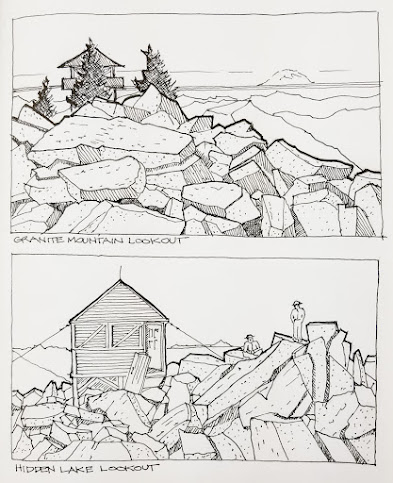
Gestalt or nuance? When we look at a photograph, I sense that we focus more on the gestalt, but when we sketch and paint, we are inevitably drawn towards more considered scrutiny of form, texture, color, light and shadow, and the relationship of objects. It’s my experience (of course, echoed by others), that painting becomes a way of seeing that deepens the perceptions and experiences of the artist. This quick pen and wash study is my first in my new Stillman & Birn Zeta notebook. And through the process, I saw the lookout scene with new eyes. I like the way the paper takes the pigments.

Having recently resumed sketching and watercolor art after a long, long hiatus I was, at first, cautious, afraid actually, of using the bush and water-based pigments to do anything beyond wash exercises. So, I thought, it was better to get my hand back in through sketching. Yes, that would be a way to wade into the waters of a spontaneous medium that celebrates boldness, a medium intolerant of fools. What to sketch? Why not cairns. Yes, cairns. They are everywhere in the Cascades and while some disdain their presence as they violate to ethics of ‘leave no trace,’ I often find them stunningly beautiful.

The cairn at the ridgeline at Maple Pass points north towards the jagged peaks of the North Cascades. Even though secured to the earth through force of gravity, they are, nonetheless, ephemeral as they do get knocked over, and added to.

The big cairn on the summit of Alta Mountain anchors a high point in the Alpine Lakes Wilderness, a place to pause and gaze. And we did, resting, snacking, and telling mountain stories as our eyes looked north.

Other favorite mountain destinations are the summits that host the historic fire lookouts. I have only hiked to 13 of Washington State’s over 90 fire lookouts. But they have all been spectacular. Of course, I have my favorites. I have been to Granite Mountain Lookout 11 times. As a subject, there is a lot to recommend for both photography and sketching. I have posted numerous spherical panoramas of it at my gallery at 360Cities.net.   And now, one of this recent pair in pen and ink. It’s a little study and I had fun with it. However, I find the boulder fields difficult. It’s not yet easy to make a fast and loose rendition. Perhaps those with fewer boulders, like Alpine Lookout, Shriner Peak, and Kelly Butte will be more accommodating.

It soon became evident that I would have no lack of subject material, even in the dead of winter, as my deep library of mountain images would provide inspiration for interpretation. And, instead of feeling that I have to render each scene accurately, I know I will feel much freer if I adapt the attitude, that as much as I need to deeply see my subject, my job is to simply use it as a reference to create a sketch or painting that stands alone as its own unique statement.


Friday, February 4, 2022

Don't Do It!

If there was ever any universal advice offered to first-time authors who wanted to self-publish their new book, it would be, “Don’t even think of designing your own cover. Hire a professional.” Did I listen? No, of course not. Last February, after my first draft was complete, I turned my attention to covers. That would be fun, would it not? Fortunately, I was a decent photographer and had a background in design. So, this should be easy, right?

My early working title was “Beers in the Stream,” but as time went on, I realized that it said nothing about the scope of the book and the story arc, except in a most peripheral way, that would surely confuse everyone, except me. So, that title simply landed on the chapter about our adventure to Lake Ingalls and the subsequent classic ascent of the North Ridge of Mt. Stuart. Unfortunately, the photo of the beers in the stream doesn’t even show up in the book.

So, I scanned my library of photographic images, both vintage and contemporary, and selected over forty that I thought showed cover potential. I cropped them and assembled them in a photo gallery to mull over. After paring it down to a dozen, I mocked them up, with half a dozen potential titles, more subtitles, and with an array of fonts. The permutations counted well over a hundred mock-ups. And even then, I wasn’t happy with the fonts.

At first, I loved the look of Charlemagne Standard, a font designed in 1989 by Carol Twombly, with basic forms modeled after those used in classical Roman engravings. But after further examination, it seemed that fancy serif fonts in color weren’t going to provide the requisite visual impact when the cover was reduced to thumbnail size on a bookseller’s website. And, it turns out that the choice of serif versus sans serif has a lot to do with the genre of your subject. No, I am not joking.

So, I went to phase two, mocking up the best contenders to pick a final font. It turns out that a bold sans serif white font has the most visual impact for book covers, at least in my chosen book genre. After trying many, I settled not on Helvetica, which I had known since my days in college as an architecture student, but on one I had never heard of before. Its name is Mesmerize. And it mesmerized me. From the moment I composed it as text over my cover photos in Photoshop, I knew it was the one. I breathed a sign of relief. Another hurdle crossed.

And from those new cover candidates, I finally picked my title, Banquet of the Infinite. The final decision on the subtitle would take even longer. While I fell in love with my night sky Milky Way photo with Granite Mountain Lookout in the foreground, I wondered if potential readers might equate the title with an exploration of the universe. No, not quite right. Next.

This early self-portrait was shot with the self-timer with my Nikon F film camera looking out at the Sierra peaks from inside Omnipotent #13, back in 1973. And while I like it, I knew it wasn’t the cover shot. It’s a crop from a horizontal image, so somewhat compromised, and I was concerned that it might be confusing, and perhaps a little busy visually. Next.

This image of me hiking up a creek bed in the Sierra appealed to me but then again, most of the memoir stories take place in the Pacific Northwest. Again, I was concerned that potential readers might be too 'concrete literal' in their expectations based on their perception of the image. Next.

I love this vintage image that I took in 1977. And, it appears in the book chapter titled “Warbonnet and Wolf’s Head.” Diane standing on the boulder, looking into the distance, under the prominent feathered crest of Warbonnet Peak, has that Maxfield Parrish ‘girls on rocks’ thing going on, and I think it’s incredibly romantic. It is, however, a bit visually busy with the graphics and it might not make sense to a potential reader when seen in an online thumbnail image on a bookseller’s site. Let’s see if I can do better. Next.

I took this shot of Dragontail Peak while pausing during the trudge up Aasgard Pass with David Stevenson in 2019. I love the drama with the fractured granite and golden larches. And we’re back in Washington. But again, is it too busy? Next.

Later, that same day, as the temperature plummeted and the gray rolled in, the image seems even more ethereal, and dare I say, infinite. Not bad, but is it the one, the one that will draw in a potential reader? And again, is it too busy? Next.

And now, simpler with more diffused light and more contrast and clarity with the title font. But is it both intriguing and welcoming? Or is it too gothic and dour? Next.

Finally. It’s a clear, crisp, simple image of Lake Ingalls with Mt. Stuart both on the horizon and in reflection. A simple grab shot from a solo hike during the 2020 pandemic turned out to be a pleasant surprise. I think it speaks to the title and is both intriguing and welcoming. Done!

My engaging mountain memoir, Banquet of the Infinite, is now available as an eBook on Amazon, Barnes & Noble, and Kobo.


Sunday, January 2, 2022

Every Step I Take

I suppose it’s like a little romance, a long-term infatuation, my interest in mountain footwear, but it didn’t start well. I moved from the Midwest to the Pacific Northwest in 1972 and started hiking. I thought I’d better get the right footwear and soon settled on a pair of lug-soled hiking boots from REI. I tried them on at their big flagship store on Capitol Hill, actually their only store. It was my first piece of purpose-built outdoor gear, and I felt it a serious purchase, arguably the single most important piece of equipment in your outdoor gear portfolio, the foundation upon which each journey rests. I had expected great things, thinking that I could rely on my new European leather Raichle boots. I thought it would be the beginning of a beautiful friendship with joyous shared mountain adventures. Sadly, it was not to be.

The whole relationship between those boots and my feet went south in a hurry. Although they seemed to fit fine in the store, the unyielding leather uppers gave no quarter to the needs of my feet on the trail. They hurt. The pain of hiking in them, along with the attendant blisters, took all of the joy out of my hike. And the pain commanded most of my attention. After just one outing, I had come to loath them, those miserable little fuckers. Yes, it was that bad, and consequently, I threw them into the back of my closet and would never use them again. I eventually gave them away.

Just a couple of years ago, as Peter Hickner and I hiked the Kendall Katwalk Trail, we talked about gear. I happened to mention my experience with those horrid Raichle boots. Peter stopped me right there and told me his story. It was the same story. Yes, the same boots, the same miserable experience. He, as I, used them only once and then tossed them aside. We both laughed at the hilarity of it, and only because it was so long ago.

Galibier Super Guides. The name was just pure magic. Sensational! The Super Guide was inspired by and named for Gaston Rébuffat, the renowned French alpinist. Famous for being the first man to climb all six of the great north faces of the Alps, Gaston was also a member of the first expedition to summit Annapurna in 1950. He lyrically recounts his climbs of the six north faces in his 1956 book, Starlight and Storm. He was a serious and romantic man whose passion for the mountains came alive in his writing.

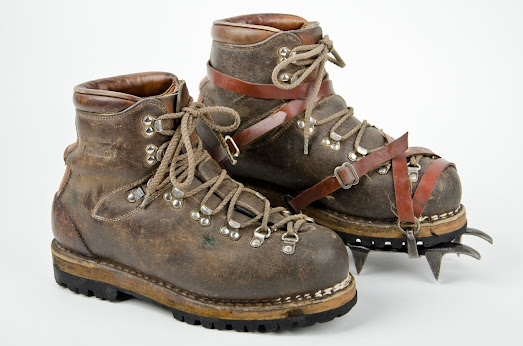
The Galibier Super Guide boots were the best boots of their time. Each pair assembled with the finest available materials, beginning with uppers made from a single piece of full-grain leather and sporting lugged Vibram rubber outsoles attached by two strong rows of stitching in a footwear construction named reverse welt or Norwegian Welting. Between the heavy leather of the midsoles and the rubber outsole lay a contoured metal shank that provided the necessary rigidity for climbing ice and snow with attached metal crampons. Another Frenchman, Richard Ponvert, manufactured the Galibier boots. All specifically designed for ascents in such places as the Alps, Dolomites, and Himalayas, as opposed to the hiking trails in the wilderness parks of the western United States.

Nonetheless, many Northwest hikers and would-be mountaineers bought the boots as they were the best available, and while a bit stiff on the approach, the uppers would eventually soften. You could tackle anything as you got higher, and the terrain got rougher and more technical. But the Super Guides were not for everyone. They had a very narrow fit, as the lasts they used emulated the actual feet of Gaston Rébuffat, so the story went (it was so obviously French, n'est-ce pas?).

So, you may ask, “What is a last?” The boot, or shoe, last is a solid foot-shaped form that's used to shape a boot, and the cavity within, when the boot is being constructed. While you may not have even considered it, it's actually one of the most important aspects of footwear construction, a critical part of footwear design that is vitally important for fit. Early lasts were made from hardwoods and contemporary lasts are usually carved from a hard synthetic material, and so are made to be used over and over without deformation. Bootmakers stitch the leather, or synthetic, upper together and then stretch it over the last to shape the boot. Then the sole is attached to the upper while the last form is still in place. After the last is removed from the boot, a foot-shaped cavity remains. And hopefully, your foot will fit well within that cavity.

That’s why it makes little sense to make a selection based on what brand or model someone else may like and recommend. Unless that is, your foot shape is very close to theirs. Every boot manufacturer has their proprietary last designs and not all will be a good fit for your feet. The best approach is to try on as many models of footwear as possible to zero in on your best fit. And then stay with that manufacturer and model range going forward, and hope they don’t change their last so it no longer works for you. If they change, you then start over.

While the range of customers that would achieve a good fit with their Super Guide was limited, Ponvert did make another boot that was practically the same. The significant difference was that while still somewhat narrow, the boot had a more generous last than the Super Guide. It could fit a broader range of feet. This model was named Peuterey, named after a famous peak on the Mont Blanc massif. I knew needed better equipment, that upon which on which I could rely. And so, my quest took a turn for the better after I bought my first Peutereys and EBs (the breakthrough sticky rubber rock shoe from France). My first pair of Peutereys came from the Boat Street Swallow’s Nest, and although they were formidably stiff, the uppers eventually relented and softened, and my feet liked them. They became my go-to boot for all things from trail hikes to technical ascents of rugged Cascade peaks, sometimes sporting my Salewa crampons. I used them so much that I eventually had to have them re-soled by Dave Page, the renowned Seattle cobbler who served the entire western mountaineering community.

Of course, my antenna were always on alert for the promise of the new. Yvon Chouinard’s company Great Pacific Ironworks introduced a new boot in the pages of its little 1976 catalog that sported a color cover photo of Machapuchare taken by Tom Frost. It was a stunning image, alpine porn, of a mountain in the Annapurna massif of Gandaki Pradesh of north-central Nepal. And it was unavailable, off the market, its highest peak having never been climbed and probably would not ever be.

The reason? No one could secure a permit from the government of Nepal to climb it. I imagine that many alpine climbing enthusiasts collectively sighed. Anyway, the Swiss boots were the most beautiful that I had ever seen (in the catalog photo).

The copy read: “We have acquired a limited supply of Carl Molitor’s EIS boot. The boot is handmade using only top-quality materials. The leather is Grade ‘A’ Russian heifer…”

It continued, extolling the features and attributes. It encouraged the customer to send a tracing of their foot with the order or stop by their retail shop for an exact fitting.

It finished by saying, "These Molitor boots are being distributed on a first-come, first-served basis."

I thought the catalog copy compelling. “Limited supply, top quality, Russian heifer, double-stitched by hand, U.S. rocker with a narrow heel to fit American feet, first-come, first-served.”

I was smitten and needed to step up to the plate.

“Stop by for a fitting.” It sounded so couture, didn’t it?

I couldn’t exactly stop in for a fitting since their retail shop was in Ventura, California (only 1,150 miles from Seattle). So, mail-order it was. I got lucky. The size I ordered fit perfectly, and they and I soon became fast friends, along with my German Chouinard Salewa rigid crampons. I found them the perfect tools for ice couloirs, and I used them with confidence on both the Black Ice Couloir on the Grand Teton and the Stuart Glacier Couloir back in the Cascades, as well as other ice climbing outings.

While they were, at the time, a superb combination, I look back and marvel at both the long approaches and multi-pitch technical climbs that I made in both my Galibier and Molitor boots. Because, for all their earthly virtues, they were damn heavy boots, both the Peuterey and Molitor boots weighed in at 6 pounds the pair.

Even Nike got into the act. And when they introduced their 1982 version of the classic hiking boot, with leather uppers, and lugged rubber sole, I was on board. I think they named the boot Magma, but I could be wrong. Nonetheless, I used them on several multi-day outings in the Cascades, including the fabled Enchantment Lakes basin. And while they were light and comfortable the only catch, and there’s always a catch, is that they weren’t waterproof. And not even Sno Seal could fix the exposed tongue construction, a virtual canal for water access. So, they were only fair-weather footwear.

My subsequent boots would be both lighter and waterproof without the need for Sno Seal. Tecnica’s Tecni-Dry boots promised both features. The lighter weight, a result of a thinner outsole bonded to the upper with modern adhesives. For some reason, I trusted them completely. And then, one day while hiking up the rocky trail toward the summit pyramid of McClellan Butte, I felt a loose flopping sensation. I looked down and saw that my lugged Vibram outsole was separating from my right boot. It was only a bit and I thought I could deal with it later, and continued. Soon the problem grew worse and finally, the entire outsole detached. I turned to descend, hobbling down on one good boot, carrying the detached sole, somewhat amused by the turn of events. I didn’t even get back to the trailhead before the remaining sole came off. No longer amusing, it was the death knell for my relationship with Tecnica mountain boots.

The Italian La Sportiva Pamirs seemed a good next choice. They fit well, were durable, and had a lace lock system that allowed variable adjustment for both the lower and upper parts of your foot. I loved hiking in them, but at four pounds, the leather boots were among the last of that era and I eventually moved on to the next technical iteration. My new La Sportiva Trango Cube GTX boots sported synthetic uppers, featured the lace lock system, and weighed in at only three pounds. I have heard that the US military has concluded that a pound on your feet is the equivalent of five pounds in your pack. So, the three pounds that I have saved (from my original leather mountain boots) by hiking and climbing in my newer, lighter boots are the equivalent of a whopping fifteen pounds in my pack!

I loved my Trango Cubes so much that I bought the Trango Ice Cubes that featured a built-in gaiter. While a fabulous boot for snow and ice, it had practically no rocker. That meant a less comfortable approach. And after five years, my Trango Cubes have worn to the point I asked myself if I should have Dave Page resole them. And then…the next generation caught my eye. La Sportiva had just introduced their Aequilibrium series of 3-season mountain boots. They seemed even lighter and the buzz was that they provided unparalleled comfort on the approaches as well as the technical sections. And they look pretty snazzy. Hmmm. And so…the quest continues.

Portions of this post are excerpts from “Peutereys and Piolets,” a story from my recently released mountain memoir, Banquet of the Infinite, now available as an eBook on Amazon, Barnes & Noble, and Kobo.


Saturday, December 4, 2021

Explorer-Chic? We’re Buying In!

Yikes! Not being ‘with it’ in any sense, I just stumbled on to this curious collaboration. Actually, a breakthrough in co-branding with two unlikely partners, or so I thought. At first, I thought it was a joke, a complete send-up, but no, it’s for real. Seriously.

My first encounter with outdoor-chic was witnessing lugged soled hiking boots making their way from concrete sidewalks into the University Bookstore and nearby LP record shops. Known then as ‘waffle stompers,’ they seemed a good accessory for patched blue jeans. They certainly didn’t see any mountain trails as our campus in central Illinois was flat as a pancake. And so, those stiff leather boots were more of a lifestyle statement than anything else.

Some years hence, post-university, we used to joke about ‘Patagucci,’ I mean Patagonia, having achieved cult status with the urban crowd. It seemed every third guy at the local grocery store wore some color of their nylon-shelled, ‘bomber styled,’ zippered fleece jacket. And later, The North Face oversized puffy jackets appeared, suddenly popular, on the streets of New York, with would-be rappers. Down mountain gear proliferated amongst the concrete walls of the city. I found it a most curious phenomenon and wondered why.

The recent The North Face x Gucci collection takes that concept several levels beyond, as Italian runway designers have adapted outdoor silhouettes to showcase their virtuosity with color, texture, and pattern. I kind of admire the cheeky panache of the assortment, a fashion design student fantasy project gone wild, and yet, made real, completely jaw-dropping both in its inventive visual creativity and prices. It seems to me that functionality takes a far backseat to the celebration of the brand, as the creative objective is not to provide performance in the mountains but to create, in the target customer, a palpable sense of desire to acquire and make a statement about one’s self.

As a former architect, and later a designer and developer of outdoor gear and apparel, I was always interested in the relationship between form and function. For me, the function was the beginning and always drove form. The evolution of form, with a pleasing aesthetic, driven primarily as a result of achieving the requisite function for the task ahead was the design imperative. Of course, this collection has little to do with the mountains except in an abstract conceptual sense and is thus free to focus on the exploration of pattern, color, and commerce. And what fun it must be to indulge in ‘celebrating the spirit of exploration’ (as the North Face website pronounces) with exuberant, whimsical designs. The beauty of it is that what comes next is only bounded by limitations of the creative imagination as little function needs to be served.

British Vogue editors penned a feature in January of 2021 and unequivocally stated their approval: “The North Face x Gucci has landed and everyone wants a slice of the technical outerwear energised by bold blooms, eye-watering colourways, and cult branding. The Vogue editors bagged a preview of the peppy puffers before they hit the rails of Selfridges, where the collection is available to purchase via virtual appointments from now until 31 January. The verdict? The cheering coats are a breath of fresh air. We’re buying in.” They further declared the collection “a breezy take on explorer-chic.”

Oversized cotton logo t-shirts range from $540 to $650, and the latest TNFG forest print tee is offered at $850. Their vintage ‘70s style mountain boots go for $1,490 and a new floral print down jacket for $3,600. Other items have commanded even higher prices. Curiously, they offer The North Face x Gucci floral print silk dress, with ruffles at the neck and cuffs. Yours for $4,500, sold in-store only. And while that may seem just right for the urban fashionista, the collection misses serving the needs of the true alpine enthusiast. And it doesn’t care. So, it’s highly unlikely we’re going to run into any of this apparel high in the North Cascades, Sierra, or Tetons. But, perhaps in the mountains of Manhattan and the Hollywood hills. Yes, definitely!

While I imagine that some at The North Face are probably suitably embarrassed by this whole co-branding adventure, there will be others elsewhere that will be envious of the collaboration, and subsequent brand notoriety, and wonder, “Why not us?” So, what’s next? Carhartt x Burberry, or perhaps the ne plus ultra of up-and-coming outdoor co-branding ventures will be Arcteryx x Armani. Yes, it’s probably already in the works. But they better hurry. It’s now a catch-up ball game.


Wednesday, December 1, 2021

Hail Falling on Granite

Darkening skies portended the fury to come. The beautiful white cumulus clouds that had graced our mid-day hike through Humphrey’s Basin had changed their character. No longer friendly drifting cotton balls scattered across brilliant cerulean blue skies, they had grown surly, now darker, towering, and more sinister. We quickly made camp, pitching our Omnipotent with a facing view toward the jagged western face of Mount Humphreys. As the sun bathed the summit with fading orange light, the sky turned a dark gray. We watched and waited.

Earlier, we had hiked into the basin via Piute Pass. The sun shone bright overhead, and the trail was a dusty, rocky affair that climbed steadily up, the heat of the day requiring frequent stops to pull out our water bottles and slake our thirst. The narrow path was well defined and straightforward, crossing through areas of subalpine meadows that hosted wildflowers, native grasses, and gnarly dwarf trees. The six-mile hike from the North Lake trailhead ascended 2,200 feet to Piute Pass. And once there, the view expansively blossomed to encompass a giant plain strewn with barren rocks and sparse grasses.

We hiked on. Even though we were now at 11,000 feet, the summer day was searing hot and dry. Needing to hydrate once more, we stopped to remove our packs and access our water bottles. My companion, Peter Hickner, paused, standing on the massive granite slabs to gaze across the giant boulder-strewn amphitheater over the still waters of the isolated Summit Lake, and then beyond, towards the high Sierra peaks that framed the distant skyline. He wore only a sun hat, t-shirt, shorts, socks, and leather mountain boots.

Mount Humphreys, at 13,998 feet, stood high above the other peaks, dominant with its iconic trapezoidal summit. As the 13th highest peak in California, it is the highest of those accessed from the eastern gateway town of Bishop. No other peak to the north rises higher. There is no easy route to the summit, but we had not come to climb and had not brought the gear to tackle any technical ascent. Instead, we brought pack rods, fry pan, and savory seasonings as we planned to fish from lake to lake as we meandered through the granite kingdom, happy just to be there.

And once ensconced in our tent, the view towards Mount Humphreys held us, hostage, to the unfolding drama. Soon, flashes of lightning, and sharp cracks of thunder surrounded us. And then, gently at first, the icy hail quickened to a loud and frenzied rush, the white pellets sweeping across the high Sierra landscape, pummeling our tent, and dancing across the dry basin soil. The wild beauty of the light show, the streaming hail, and the majestic Mount Humphreys seemed operatic, Wagnerian, in those moments. And though, in some ways, we did not want it to end, we knew that it would and that we’d be relieved when it was over.

And soon it was. Once done, the storm having exhausted its fury, the sky resumed its changing light as the sun drifted over the western peaks sending dramatic flares of light before the approaching dark of night. As the temperature had plummeted, we emerged from our tent, more fully clothed, to survey the scene. We both admired what the storm had left behind, the moist landscape of granite boulders, scrubby trees, and scattered white hail pellets. As quickly as the storm had manifested itself, it released its fury and quickly moved on. It was so different from the incessant and lingering cold wetness we were so accustomed to with mountain storms in the Pacific Northwest. And for that difference alone, we were glad that we had come.

I had fallen in love with the Kings Canyon area of the Sierra many years before, when a girlfriend and I first explored the Mount Goddard quad. At first, we followed the dusty trails, and then later broke away. We’d travel off-trail following the contours of our topo maps, hiking up the drainages of streambeds and cascading waterfalls to fish remote and seldom visited lakes with scattered boulder shoulders. If you wanted to simply wander and discover, this was a good place. More than good. Sensational.

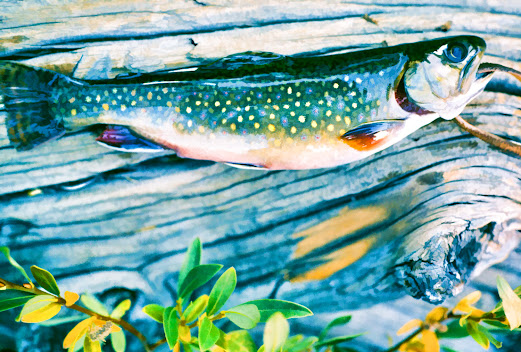
As Peter and I traveled the basin we were surprised to discover some shallow tarns alive with vigorously wriggling dark shapes, tadpoles. Surprisingly large, we wondered why they were there. Only later would I learn that the mountain yellow-legged frog (Rana muscosa) was once a common inhabitant of the California Sierra Nevada. They later declined precipitously during the past century due in part to the introduction of nonnative fish, brook trout, into naturally fishless habitats. However, on that day, during our traverse of the basin, both tadpoles and brook trout co-existed.

As I look back, I acknowledge that those early days of our exploration of the Sierra revealed to me, much more emphatically than I could ever have imagined, the ethereal magic of nature. My experience was profound and the beginning of my deep spiritual communion with the wild places of the mountains. And for that, I would be forever grateful.

More stories of my early explorations of the Sierra, Cascades, Tetons, and Wind River Range are included in my recently released memoir, Banquet of the Infinite, which is now available as an eBook on Amazon, Barnes & Noble, and Kobo.

Old Trophies

What is it about trophies? Well, they have more expansive dimensions and weight than a paper certificate. We can gently cradle them in our h...

Beers in the Stream